


As Microsoft continues to make significant progress in its AI-based ecosystem, the company is keen on making a game-changer with a particular tool. Now, individuals can engage with information on the internet through Microsoft Copilot. Copilot is indeed more than an assistant, as it is built into Windows 11 and embedded in Microsoft 365 and Edge. It combines generative AI with real-time web data to transform how people consume, query, and trust content.
This development necessitates a new strategy for SEO professionals and marketers. The alignment of your SEO strategy with Copilot implies the optimization, not only of the traditional ranking on the search engine. Additionally, it involves AI-enhanced delivery, summarization, and contextual retrieval of the content. As this runs on Bing, it is essential to learn about its algorithms, integration opportunities, and content requirements to attain visibility.
We examine the provision and presentation of information in the current outline. It also includes the unique features of Bing and how to strategically position your SEO to capitalize on the era of AI-driven search companions.
Contents
Understanding Copilot’s Information Sourcing and Logic
To harmonize your SEO with Microsoft Copilot, it is crucial to understand how this AI sidekick collects, analyzes, and provides data. Copilot is not about the fixed search engines known to be searching through ranks or a fixed SERP. Instead, it dynamically generates answers by using a combination of real-time querying of Bing, proprietary large language models, and context-aware reasoning. As a user enters a query, the Copilot model tries to understand its purpose through conversational AI. Then, it queries multiple sources, including indexed websites and a structured data repository, to obtain the most reliable and trustworthy information.
The thing is that Copilot was able to synthesize responses with passage-level retrieval. This means it can spot and retrieve the exact segments of text within a page, not just the page itself. Copilot enables it to answer questions in a precise manner, despite the entire page perhaps touching on a broad topic. In addition, Copilot’s design remembers the context of the conversation.
Copilot can do even more in enterprise settings. Where it has access to Microsoft Graph and can retrieve organizational data as it appears in emails, Teams messages, files saved in OneDrive, etc. This merging of publicly available web knowledge with privately held cloud data will allow Copilot to generate highly relevant and personalized responses based on the user’s ecosystem. As an SEO expert, it means that the content will no longer be sufficient when it is merely correct and well-organized. It should also be targeted at AI parsing to be ready to be parsed as a self-contained paragraph that answers the possible question well. This logic is the basis for not just making your content visible. Additionally, it can surface in Copilot through its smart summaries.
The Bing Foundation
Leveraging Microsoft Graph & Internal Data
Copilot does not only use public web information. In business environments, it integrates with Microsoft Graph, utilizing Outlook, Teams, OneDrive, SharePoint, and other factors to respond to business questions. The easy access to structured internal information draws out the following kind of SEO implication:
You should optimize content housed in a Microsoft 365 environment to be searchable and understandable within the organization.
Where web-facing content is concerned, this translates into making value, headings, and relevance clear even in document formats. Such as indexed PDFs or Microsoft files posted on the web. Suppose thought leadership or research can support your organization in one of these forms and make them searchable, well-organized, and with metadata attached to them.
Passage-Level Retrieval
Optimizing the title and H1 of a page might not be enough using traditional SEO optimization techniques. Copilot, as is the case with Bing Chat, operates at the passage level. It identifies particular fragments of a page that directly respond to a question posed by a user. That is why every paragraph, subheading, or list should be self-sufficient and based on a potential search intent.
That is why micro-optimization is essential. It is imperative to write each part of your piece with a possible question in mind. And to apply schema markup or semantic HTML to make a search engine understand it.
Conversational AI & User Intent
Copilot maintains context and follows up on numerous user interactions. It implies that the search intent may change dynamically, and your content should fit various purposes and use cases, including long-tail keywords, in one article.
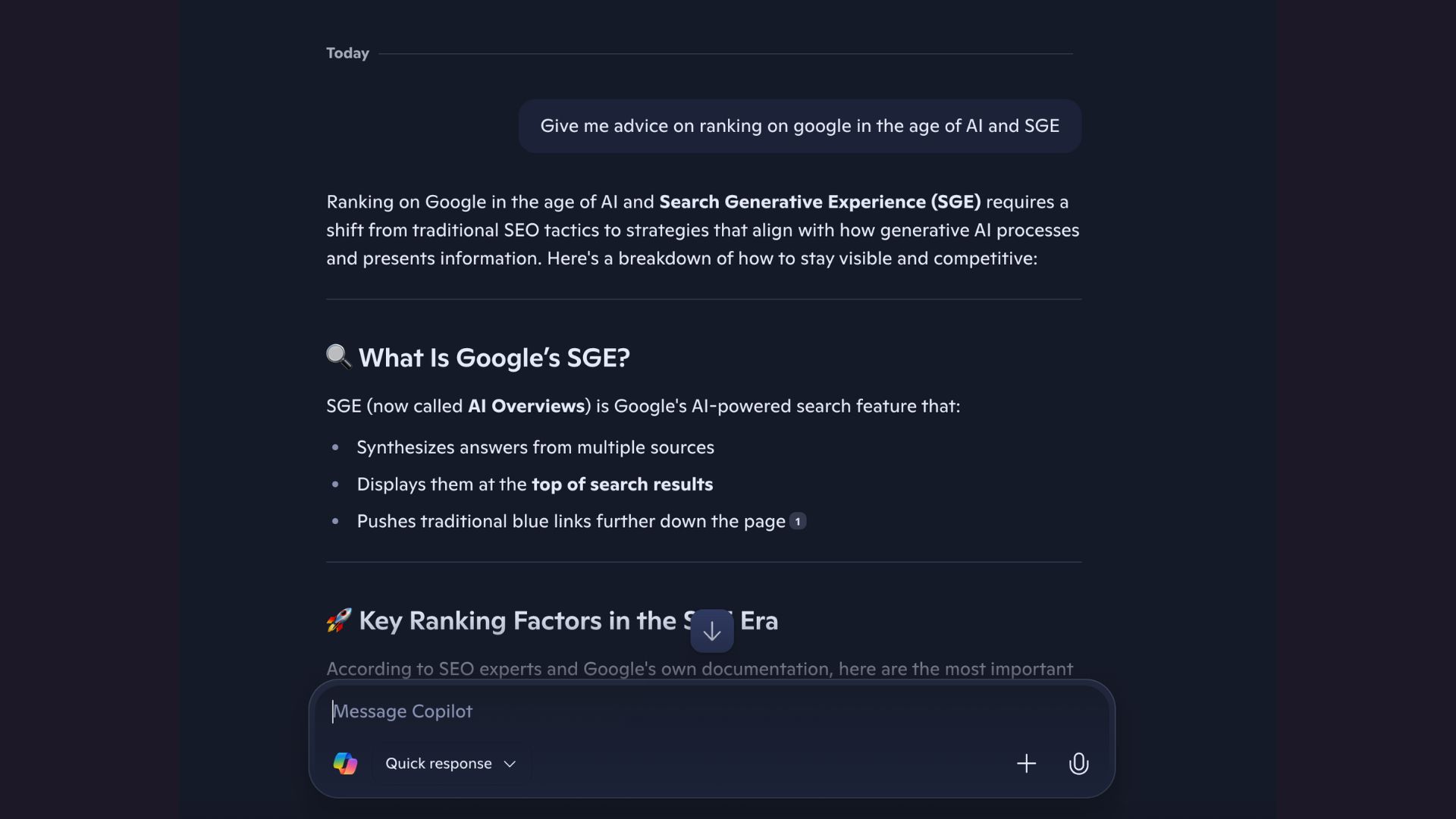
What you should expect is not just what the users are seeking, but also how they are asking. That would include more question-like conversations, voice-like interactions, and even more conversational follow-ups. Such as asking, “Why is it essential?” or “What is a good example?”
SEO Foundation: Optimize for Bing
Master Bing Webmaster Tools
Where Google Search Console is your default source of information on traditional SEO, Bing Webmaster Tools (BWT) is now the must-have. So that you can stay up to date on content optimized for the Microsoft AI ecosystem. BWT provides crawl status, search terms, links, and indexation, enabling you to optimize your site for Bing tools.
It also features an SEO Analyzer that highlights issues with the page, metadata, mobile friendliness, and indexability. Take advantage of BWT features to acquire a proficient Copilot-ready SEO roadmap and measure how Bing treats your site in comparison to Google.
Technical Excellence
The Bing crawler, known as Bingbot, is getting smarter and is rendered in JavaScript. However, clean HTML keeps the upper hand. Ensure that your technical SEO is immaculate:
An appropriate utilization of canonical tags.
- Submission of sitemaps.
- Ensure that they load quickly, particularly on Edge.
- Use HTTPS, mobile first, and clean inner linking.
- There is also no need to thin or duplicate content. Each page should have a purpose and a semantic treatment, which will help it rank at the passage level and show better representation in Copilot.
Bing-Specific On-Page Optimization
Bing tends to favor exact match keywords and domain authority, as well as metadata optimization, over Google. The title tags, meta description, and headlines should be descriptive and accurate, as well as contain your selected keywords.
Optimize based on the guidelines of Bing:
- Use target keywords in a very natural but straightforward approach.
- Utilize the use of structured headers (H1, H2, H3) to organize some of the topics.
- Meta descriptions should be short yet informative.
- Another factor that Bing considers is the click-through rate and user engagement rate. To make your title/meta appealing to read and arouse curiosity so people interact, include more than just keywords.
Content Optimization for Copilot’s AI Engine
Write for Direct Answers
Copilot frequently draws on snippets that are more answer-like in an FAQ or definition-like. Stitch your content up and make it have:
- Crude, laconic sentences at the top of paragraphs.
- Question-style subheadings.
- The bullet points and the lists summarize the complex ideas.
- Draft is an AI-friendly way of writing that can be easily paraphrased, quoted, and summarized. It will find the most advantageous position in Copilot summaries or answer boxes.
Enhance E-E-A-T
Bing, like Google, considers Experience, Expertise, Authoritativeness, and Trustworthiness (E-E-A-T) as factors in credibility. Another emphasis given by Microsoft to brand alignment and authorship identity is in Edge queries and Copilot queries.
Bibliographies, referrals, and good source attribution. You can cite verified entities, list the material on a secure server, and ensure that you can tailor your brand presence to its knowledge specialty.
A byline by a professional about a topic, or an integration of your LinkedIn profile (which is crawlable by Bing), can help build the authority of your content among the Microsoft user base.
Structured Data
Copilot uses organized data to comprehend content on a large scale. By using schema markup, particularly that of FAQPage, HowTo, Product, and Article schema, you can display your content correctly and more often in AI-enhanced sections.
In addition to the base schema, you might want to incorporate Open Graph, Twitter Cards, and a few others (like MSSearch or Microsoft-specific). This makes your content ready to be discovered on multiple surfaces, on Windows, Edge, and Microsoft 365 integrations.

Conversational & User-Centric Tone
Copilot performs the same functions as humans in the conversation process – i.e., your text must be precise, provide assistance, and sound human-like. Write in a tone of direct question/answer, possible distrust, and an understandable language.
Do not use jargon where possible, and after explaining a complex concept or idea, provide a sample, such as an example or an analogy. Not only does this enhance Copilot pickup, but it also aligns with Microsoft’s user empowerment and accessibility orientation.
Content Freshness
Bing powers Copilot, and it is becoming more favorable to up-to-date content. Publish content frequently on the internet, update previous blogs on the website, and include a timestamp or last update label. Copilot can retrieve various older versions of your content when historical context is relevant, but it is common to see older updates in AI responses.
In news or evergreen, ensure that your XML sitemap update is correct, and your content headers should show what is new.
Strategic & Ecosystem Alignment
Local SEO for Bing Places & Copilot
When you work in a local company or target a local population, Bing Places helps you access Copilot localized answers and visibility. You have to make sure that you are:
- Completely purloined and rational.
- Being, or being like, your NAP (Name, Address, Phone Number) with directories.
- It also includes pictures, working hours, and descriptions of services.
- Users use Copilot to get answers to specific locations, such as “What is the best Thai restaurant nearby?” Or is the clinic open today? Copilot often makes mention of Bing Places when responding to such inquiries.
Social Signals
Bing has more direct integration of social media than Google. You can use references, reposts, and even LinkedIn activity (a Microsoft product) to weigh the importance of the sources of content presented to Copilot.
Promote content sharing through Microsoft-aligned platforms and incorporate social proof, testimonials, or follower counts into your pages. The higher the visibility your material gets in the public square, the more it looks trustworthy to the algorithms of Copilot.
Integration with Microsoft 365
To enterprise content creators, matching SEO with Copilot implies an expansion of mind where it not only addresses the web. Suppose your company has Microsoft 365, then you can search your documents, presentations, and even chat conversations with the help of internal Copilot search.

Be sure to make your interior content:
- Properly titled.
- Metadata-tagged.
- In easily retrieved folders.
- Well-written in a clear and concise style.
- That enables Copilot to generalize and deliver this data at meaningful places throughout the employee experience, generating an inside SEO technique of your brand.
Monitoring Copilot Mentions
Unlike the conventional search engines, those drawn by AI do not necessarily connect. It is possible to be in a Copilot and not know the name of the person you’re working with. But in that, how do you look at the performance?
Include the following:
- Keep a watch on who is a user of Bing Chat.
- The application of log files and Bing Webmaster Tools to analyze the crawling patterns.
- Moreover, you can monitor your Brand name/URL at AI-generated snippets.
- Visit Edge-based tools of analytics and Copilot windows previews to observe the frames of your content.
- You can also discover tools like Microsoft Clarity, which provide user behavior analytics, to see how users engage with Copilot-powered results on your website.
Conclusion
There exists another AI Chatbot, Copilot, by Microsoft, and it is not simply a step in a new direction of search, but an advancement. As we integrate AI companions into our operating systems, browsers, and even work environments, SEO specialists must shift away from outdated strategies. They need to learn how the Bing algorithms can aid Copilot and how to write in a way that covers an audience with both human readers and AI engines.
The Copilot will focus on structured, authoritative, conversational, real-time content, aligned with the rest of the Microsoft product range. It will also include Bing Places and Microsoft 365, as well as Edge and Graph.
The (not so) long-term horizon is that brands that can meet this AI-powered framework will not only enjoy more substantial exposure in search. They should also be trusted sources to interface with a more intelligent and more contextual digital landscape that users deem intelligent and accommodating.
FAQs
What is the difference between Microsoft Copilot and conventional search engines, such as Google?
Microsoft Copilot is an artificial intelligence-based tool that provides conversational responses to written inputs by summarizing materials found in Bing, Microsoft Graph, or other sources. Copilot differs from traditional search engines in that it does not list links; instead, it retrieves real-time, specific information.
The answer is, why is Bing optimization relevant in the Copilot era?
Given that Copilot uses Bing as the technology behind it, to be present in the Copilot summaries, good Bing SEO is necessary. Copilot involves learning how to utilize Bing Webmaster Tools, structured data, and passage-level retrieval optimization to ensure your content appears in AI-generated results across Microsoft.
What kind of text does Copilot like to present in its response?
Copilot is authoritative, concise, and structured content. For each of the questions, well-written paragraphs explaining straightforwardly, how-to guides, and FAQs lead to good ratings. Optimizing E-E-A-T and adding schema markup will help ensure your content is selected to provide Copilot-generated answers and summaries.
Does Bing Places allow businesses to become visible to Copilot?
You can find the Reputation Profiles with Verified Bing Places listings in the local responses of Copilot. Maintaining current business information, such as hours, services, and photos, enhances the business’s search visibility. People query location-based data, as scientists note, especially when using Windows or Edge search.
How can I track whether Copilot is stealing my content?
Even though Copilot does not always backfeed, one can monitor its usage with Bing Webmaster Tools, brand mention monitors, and page-by-page engagement tracking. Additionally, you can use tools like Microsoft Clarity to analyze user behavior on AI-assisted traffic from Bing or Edge.