


With the rise of digital job searching platforms, LinkedIn has become an extraordinary way to turn your job profile into a lead magnet. Moreover, the main reason your LinkedIn profile is chosen is that it no longer validates as a digital portfolio, but instead as a primary and crucial business asset.
In this article, we will discuss the LinkedIn optimization checklist and how to turn your job profile into a lead magnet in 2026.
Contents
- 1 What Is LinkedIn Optimization?
- 2 LinkedIn Optimization vs. Personal Branding
- 3 LinkedIn Profile Optimization Checklist
- 3.1 LinkedIn Checklist #1: Clear Positioning above The Fold
- 3.2 LinkedIn Checklist #2: Headline That Attracts The Right Audience
- 3.3 LinkedIn Checklist #3: “About” Section That Converts (Not Brags)
- 3.4 LinkedIn Checklist #4: Profile Photo And Banner Optimization
- 3.5 LinkedIn Checklist #5: Experience Section Written For Prospects
- 3.6 LinkedIn Checklist #6: Skills, Endorsements, And Authority Signals
- 3.7 LinkedIn Checklist #7: Featured Section = Lead Magnet Zone
- 3.8 LinkedIn Checklist #8: Keyword Optimisation for LinkedIn Search
- 3.9 LinkedIn Checklist #9: CTAs That Turn Visitors into Conversations
- 3.10 LinkedIn Checklist #10: Activity And Content Alignment
- 3.11 LinkedIn Checklist #11: Profile Freshness Signals (2026 Advantage)
- 4 Common LinkedIn Optimization Mistakes to Avoid
- 5 Examples of High-Converting LinkedIn Profile Structures
- 6 Quick LinkedIn Optimization Checklist Summary
- 7 In Conclusion
- 8 FAQs
What Is LinkedIn Optimization?
You can mainly refer to LinkedIn optimization as a procedure for changing your profile from a digital CV into a conversion-oriented asset. Instead of categorizing responsibilities and roles, an efficient LinkedIn profile carries different attributes such as:
- Attracting the proper audience.
- Communicating with authentic value.
- Taking prompt actions.
How LinkedIn Profiles Get Discovered (Search + Recommendations)
The primary objective of LinkedIn is to highlight the audience regarding the most pertinent profiles for their search results, depending on their intentions. For example, it can be a search for professionals, service providers, or a probable client connection.
Why Optimized Profiles Attract Inbound Leads?
Moreover, an optimized LinkedIn profile also demonstrates itself directly to its targeted audience. For example, some of these factors are:
- Results.
- Language.
- Queries.
LinkedIn Optimization vs. Personal Branding
LinkedIn profile optimization generally involves organizing your profile to be conversion-oriented, searchable, and clear.
On the other hand, personal branding mainly indicates your brand presence alongside its opinions, personality, voice, and values. Nonetheless, you can also refer to these points for more clear understanding:
Visibility vs Conversion
Through the visibility of personal branding, you can grow your online presence. For example, visibility is responsible for different factors, such as how the audience remembers, notices, and feels relevant to you.
Conversely, conversion from LinkedIn profile optimization can change visibility into action. If you have an optimized LinkedIn profile, it instantly highlights the services you provide and the audience you work with.
Looking Good vs Generating Leads
LinkedIn profile optimization generally indicates functionality over presence. Also, it is not just about presenting yourself organized to the audience but about earning optimal outcomes. Moreover, an optimized LinkedIn profile can extinguish several queries a prospect can ask, such as:
- What kind of audience do you generally target?
- What kinds of problems can you solve?
- How would you measure the next step for success?
Content-First vs Profile-First Approach
There are several factors that a content-first approach generally looks for. For example, they are mainly commenting, posting, and sharing different insights to create visibility.
In contrast, a profile-first approach mainly highlights your LinkedIn profile as a foundational base. The entire process makes that despite being cold outreach on your content, it changes flows into conversions.
Why Branding with Optimization Fails?
Personal branding is mainly about perception, which indicates several factors such as your voice, style, and the prominence you communicate. Although efficient branding can make your profile visible, popular, and memorable,t visibility alone is insufficient for creating leads.
LinkedIn Profile Optimization Checklist
LinkedIn Checklist #1: Clear Positioning above The Fold
Why The First 5 Seconds Matter?
The first 5 seconds are crucial for the LinkedIn profile optimization checklist because they determine several factors regarding your profile. For instance, it generally highlights whether your posts and services are credible, worth the time, and relevant.
Headline + Photo + Banner Alignment
- Headline: It can move your job title while implementing the formula of who you assist, what queries you can solve, and the outcome and results of your work.
- Photo: Your LinkedIn profile picture has to be approachable and professional while using a high-resolution and clear headshot with a neutral environment.
- Banner Alignment: The LinkedIn profile can help you with reinforcing your message while being visually supportive of your positioning. Moreover, the positioning mainly includes crucial outcomes, tagline, and value proposition.
Moreover, as a rule, visitors should know several factors, such as:
- Who do you help? To indicate the audience you generally help, you have to implement certain descriptors such as company size, problem type, industry, and role.
- What problem do you solve? For this point, you mainly have to showcase by detecting the crucial pain point while focusing on a certain problem your client generally struggles with.
- What result do you deliver?: For highlighting the results you deliver through your work, you have several points like focusing on measurable outcomes, positioning the outcome above the roof, and connecting the quarry to the result.
LinkedIn Checklist #2: Headline That Attracts The Right Audience
Why Job-Title-Only Headlines Do Not Work?
There are many reasons behind the inability of the job-title-only headlines on LinkedIn. For instance, some of the reasons are:
- Not communicating efficient value.
- Not searchable for your relevant audience.
- Prospects not being pre-qualified.
Keyword + Benefit-Based Structure
A headline serves more importance than post titles, as it is your first pitch. Also, to attract the relevant ideal leads, you have to integrate the right keywords with benefits. Moreover, it also indicates the difference between a visible profile and a profile that turns conversions into leads.
Example Formats: “I help (who) achieve (result) with (method)”.
- The ‘who’ of the example formats mainly indicates your ideal audience, such as a certain industry, role, or inquiry owner.
- The ‘result’ mainly highlights the tangible or measurable outcome that your audience primarily focuses on.
- The ‘method’ presents how you deliver the outcome, such as your approach, service, or process.
Character Limit Best Practices
To ensure an attractive headline, you can implement various character limit practices for the LinkedIn optimization checklist, such as:
- Keeping it complete and concise.
- Front-loading your keywords.
- Implementing a separator tactically.
- Testing for impact and clarity.
LinkedIn Checklist #3: “About” Section That Converts (Not Brags)
First 2-3 Lines = Direct Value Statement
You can generally consider the first 2-3 lines of your LinkedIn about the section above the fold in most cases. Moreover, these lines are the first things your visitors notice after the headline. Also, in these few moments, you need to ensure several things, such as:
- Grabbing proper attention and engagement.
- Communicating with clear values.
- Making the visitor scroll further.
Address Audience Pain Points Clearly
Once you have established the first 2-3 initial lines, the next step will include your comprehension of the challenges of your audience. In this case, you mainly have to begin with frustrations, obstacles, and problems that your audience encounters. Story + Proof + Solution Structure
Each facet plays a different significance in terms of the ‘about’ section of LinkedIn. For instance, the story humanizes the journey, the proof establishes credibility, and the solutions point towards the next path.
End with A Soft CTA
If you want to end the ‘about’ section of your LinkedIn profile with a soft CTA, here are a few points you can refer to:
- Making the next step clear.
- Keeping it low-pressure.
- Reinforcing value for the last time.
Ideal Length And Formatting Rules
- The ideal for the about section of LinkedIn should include pain points, initial 2-3 lines, soft CTA, etc.
- Conversely, the formatting rules mainly include line breaking, bullet points, plain language, and consistent tone.
LinkedIn Checklist #4: Profile Photo And Banner Optimization
For LinkedIn profile optimization, your profile photo and banner optimization both serve as crucial factors. For example, here are some points:
Trust Signals in Profile Photos
For sending trust signals through your profile pictures on LinkedIn, you generally have to ensure several points. For example, you have to make it professional, high-quality, face forward, while dressing appropriately with a simple and clean background.
Background, Lighting, Expression Rules
- The background should be clean and uncluttered with simple or neutral settings.
- The lighting rules should include implementing soft or natural lightingto avoidg overexposure and harsh shadows.
- For expressions, you have to maintain an open posture, smile naturally, and have proper eye contact with the camera.
Nonetheless, you can also use the banner as a silent pitch in different aspects, such as:
- Offer: It mainly highlights your services and the people you assist.
- Credibility: It generally helps the audience to rely on you even before reading your profile.
- CTA: You can mainly refer to CTA as a visual nudge that informs visitors regarding their next step.
Common Visual Mistakes To Avoid
To ensure an optimized profile photo and banner, there are various general visual mistakes you can avoid. For example, they are mainly distracting backgrounds, misaligned messaging, unreadable texts, etc.
LinkedIn Checklist #5: Experience Section Written For Prospects
Writing For Clients, Not recruiters
If you want to write for clients and not for recruiters in your experience section, you mainly have different points. For example, they are:
- Focusing on the audience’s perspective.
- Emphasizing results, not responsibility.
- Implementing client-driven language.
Replace Responsibilities With Outcomes
For the following process, it is crucial to initiate each paragraph or bullet point with a contextual result. Moreover, you also have to quantify wherever possible, alongside connecting trust to your audience.
Adding Proof, Numbers, And Results
In LinkedIn profile optimization, adding proof mainly indicates creating trust,t while numbers generally highlight credibility, and the results also mean the outcome of your optimization strategies.
Using Links, Media, And Case Studies
The links, case studies, es and media generally serve as experimental and visual evidence. These facts mainly assist your clients in confirming your claims without requiring any robust explanations.
Keyword Placement Tips
You can follow a variety of keyword placement tips for a LinkedIn lead generation profile, such as:
- Starting with your first lines and role titles.
- Implementing variations, not repetition.
- Neglectingto hideg keywords only in media titles or links.
LinkedIn Checklist #6: Skills, Endorsements, And Authority Signals
Choosing Skills That Improve Discoverability
There are several that you can choose to optimize discoverability for your LinkedIn profile, such as:
- Implementing language that mirrors the market.
- Endorsementiss a thin social evidence.
- Checking your skills in the discovery process.
Removing Filler Skills
Removing filler skills is essential as they mainly generate noise without optimizing credibility. Moreover, removing such skills also increases your authority alongside your expertise.
How Endorsements Influence Perception?
Endorsements mainly impact perception by alignment, especially when the most-endorsed abilities match with case studies, headlines, andthe perience section, they showcase a presentation on your proficiency.
Why Recommendations Matter for Lead Trust?
Recommendations mainly highlight the experience of your LinkedIn audience. Moreover, they also serve as social evidence that is not easy to self-manufacture.
How to Ask for Strong Recommendations?
There are many ways you can ask for recommendations for optimizing your LinkedIn profile, such as:
- Choosing the proper audience.
- Being specific regarding the context.
- Inquiring right after a successful project.
LinkedIn Checklist #7: Featured Section = Lead Magnet Zone
What to Feature? (And What Not to)
For the featured section, some of the things you have to feature are framework, swipe file, free guide, etc. Conversely, you should also refrain from posting things that are:
- Irrelevant or outdated content.
- Too many links.
- ‘About me’ content.
Best-Performing Featured Assets
- Lead Magnets: You can mainly refer to them as assets that generate saves, clicks, and DMs if featured properly.
- Case Studies: For them, you generally have to focus on a certain quarry, client, and an optimal result.
- Calendly/ Contact Links: These links only function well as a framed solution, not as a request.
Optimising Featured Content for Clicks
One of the most prominent ways for optimising featured content is visuals, as an intentional and clear thumbnailindicatese proficiency and value immediately.
LinkedIn Checklist #8: Keyword Optimisation for LinkedIn Search
How LinkedIn Search Works?
LinkedIn searches generally operate through scanning various things, such as profile strength and keyword relevance. The platform mainly inquires the relevance of your profile text to the words you type.
Where to Place Keywords?
- Headline: You primarily have to combine factors such as outcome, audience, and role for optimal results.
- About: The focus for the about section should be your general keywords in the first few sentences.
- Experience: Your primary focus should be on the sections like experience titles, which mainly highlight discoverability.
- Skills: For skills, you can focus on the tools, proficiency, and capabilities as they serve as a searchable portion for your LinkedIn profile.
Avoiding Keyword Stuffing
For neglecting keyword stuffing, you can implement general keywords in your headline. Moreover, the key is to focus on the tactical placement rather than frequency.
LinkedIn SEO vs Google SEO
LinkedIn SEO mainly refers to the profile-oriented and intent-driven procedure,,e while Google SEO indexes millions of webpages while rewarding backlinks, content depth, etc.
LinkedIn Checklist #9: CTAs That Turn Visitors into Conversations
Where CTAs Naturally Fit on Profiles?
There are many places where CTAs fit naturally, such asthe headline, featured, and about sections. Moreover, you mainly have to match them with the visitor’s stage of awareness for handling higher commitments.
Soft CTA vs Direct CTA
A soft CTA is generally low friction,n which creates curiosity. Conversely, a direct CTA is explicit and generally demands instant, strict actions.
DM Prompts That Feel Natural
An authentic DM prompt generally includes various characteristics such as:
- Simplicity.
- Relevance.
- Low-pressure.
Examples of High-Converting CTAs
Some of the examples of high-converting CTAs include featured section CTAs, headline CTAs, contact info CTAs, etc.
LinkedIn Checklist #10: Activity And Content Alignment
Why Your Activity Section Matters?
Your activity section is crucial because it highlights factors such as relevance, credibility, and activity, as both the platform and visitors both value engagement.
Content That Supports Your Positioning
Some of the content that might support your positioning includes several fields like education, proof-oriented, and relevant stories.
Posting to Reinforce Authority, Not Chase Likes
If you post tactically on LinkedIn, each update will support your positioning. Moreover, it will also highlight proficiency and direct the audience to the CTA or conversations.
Profile Optimization vs Content Strategy
LinkedIn profile optimization is one of your primary goals, which makes sure that whenever an audience visits your profile, they instantly become familiar with your work and identity. Conversely, content strategy generally refers to the engine that is responsible for driving engagement and visibility.
LinkedIn Checklist #11: Profile Freshness Signals (2026 Advantage)
Updating Profile Every 30-60 Days
Updating your LinkedIn profile can offer several benefits, such as:
- Enhanced visibility.
- Keeping recent skills and achievements.
- Increasing networking opportunities.
Refreshing Headlines And About Section
You have to refresh your headlines and about sections for various advantages,s such as:
- Enhancing search visibility.
- Increasing engagement.
- Reflecting progressive positioning.
Updating Featured Links And Offers
It is also important for you to update your offers and featured links, because it can:
- Indicate activity on LinkedIn.
- Showcase your current offers.
- Regulate trust and credibility.
Why Freshness Impacts Reach And Trust?
Freshness influences trust and reach in many ways, for example:
- It can enhance your algorithmic reach.
- Freshness creates human reliability.
- Slight fluctuations compound over time.
Common LinkedIn Optimization Mistakes to Avoid
- Generic Positioning: Generic headlines and titles mainly highlight roles instead of outcomes, which can create a negative impact on engagement.
- Talking Only About Yourself: Self-prioritizing can also be harmful, as people are looking for ways to solve their queries, not your personal details.
- No Clear Offer or CTA: Inefficient CTA or clear offers mainly put the engagement rate at risk while also not guiding a prospect towards the next step.
- Over-optimising without a strategy: The following process mainly leads to communication failure as it does not contain any prospects and compelling stories.
- Inconsistent Messaging Across Sections: Unreliable or inconsistent messaging mainly arises from focusing strategy in a particular section, which can ultimately reduce both trust and credibility.
Examples of High-Converting LinkedIn Profile Structures
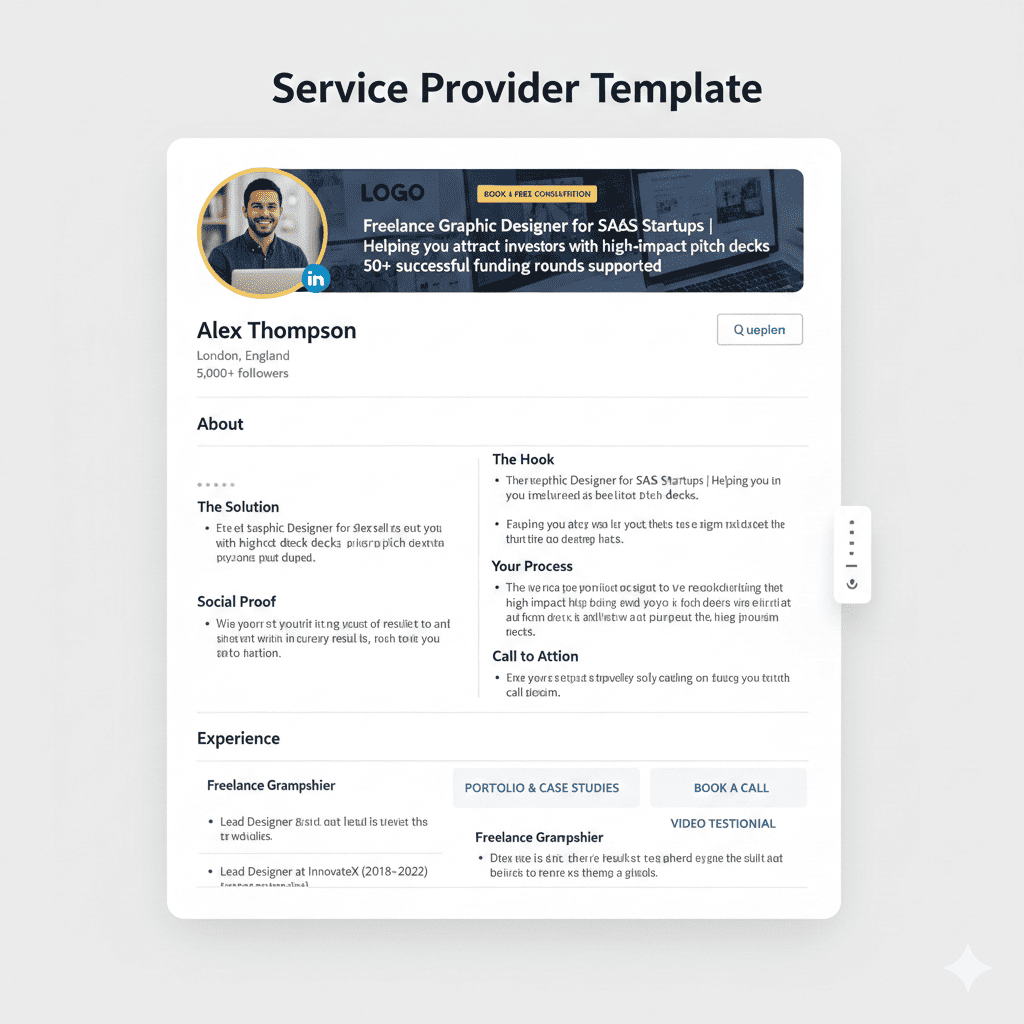
Service Provider Profile Template
You can mainly refer to it as a pre-structured facility for optimising your LinkedIn profile. Moreover, it can also provide various benefits such as conversions, discoverability, and credibility.
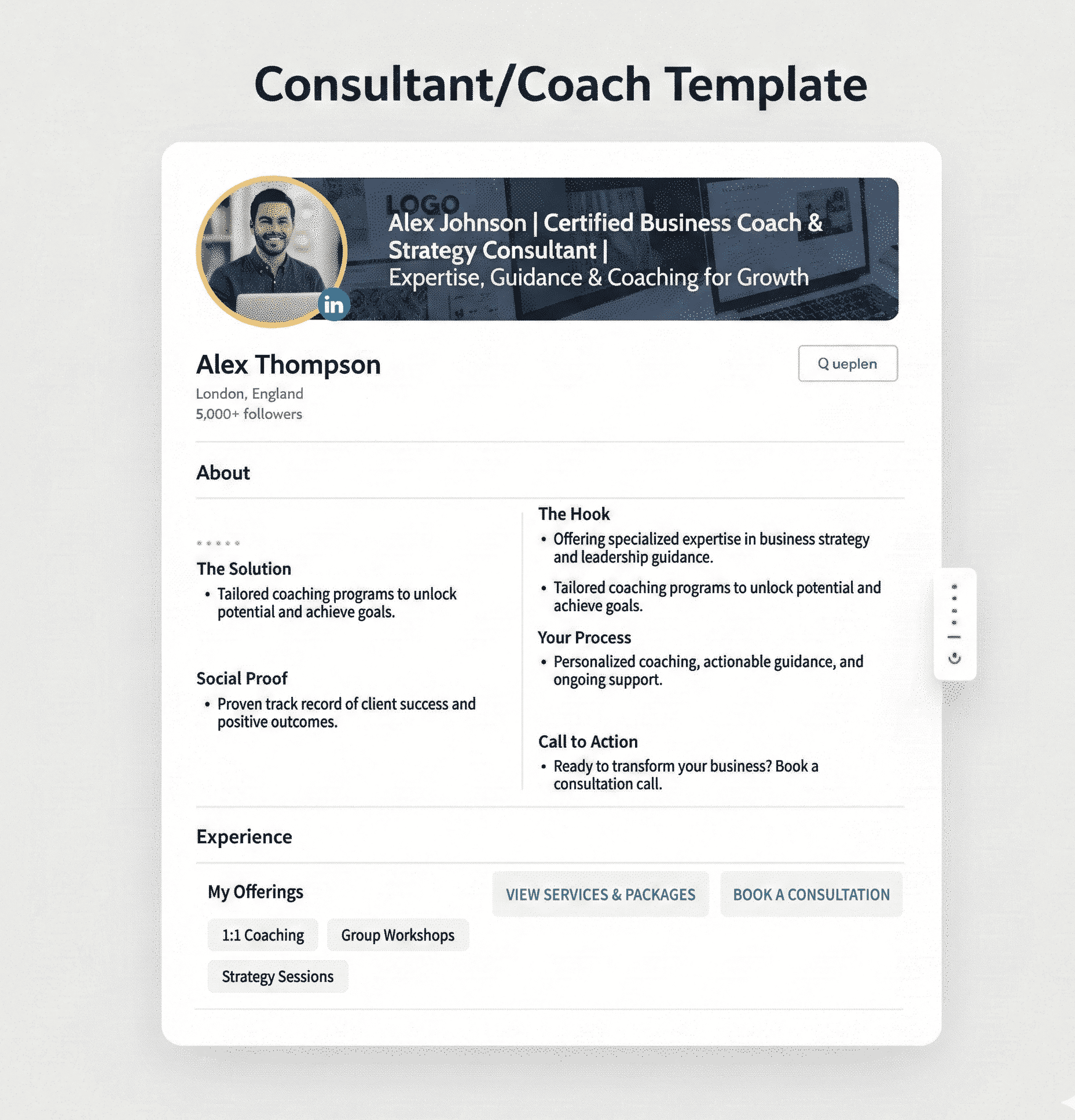
Consultant/Coach Profile Template
The following template is mainly suitable for service providers who offer different kinds of services, such as:
- Expertise.
- Guidance.
- Coaching.
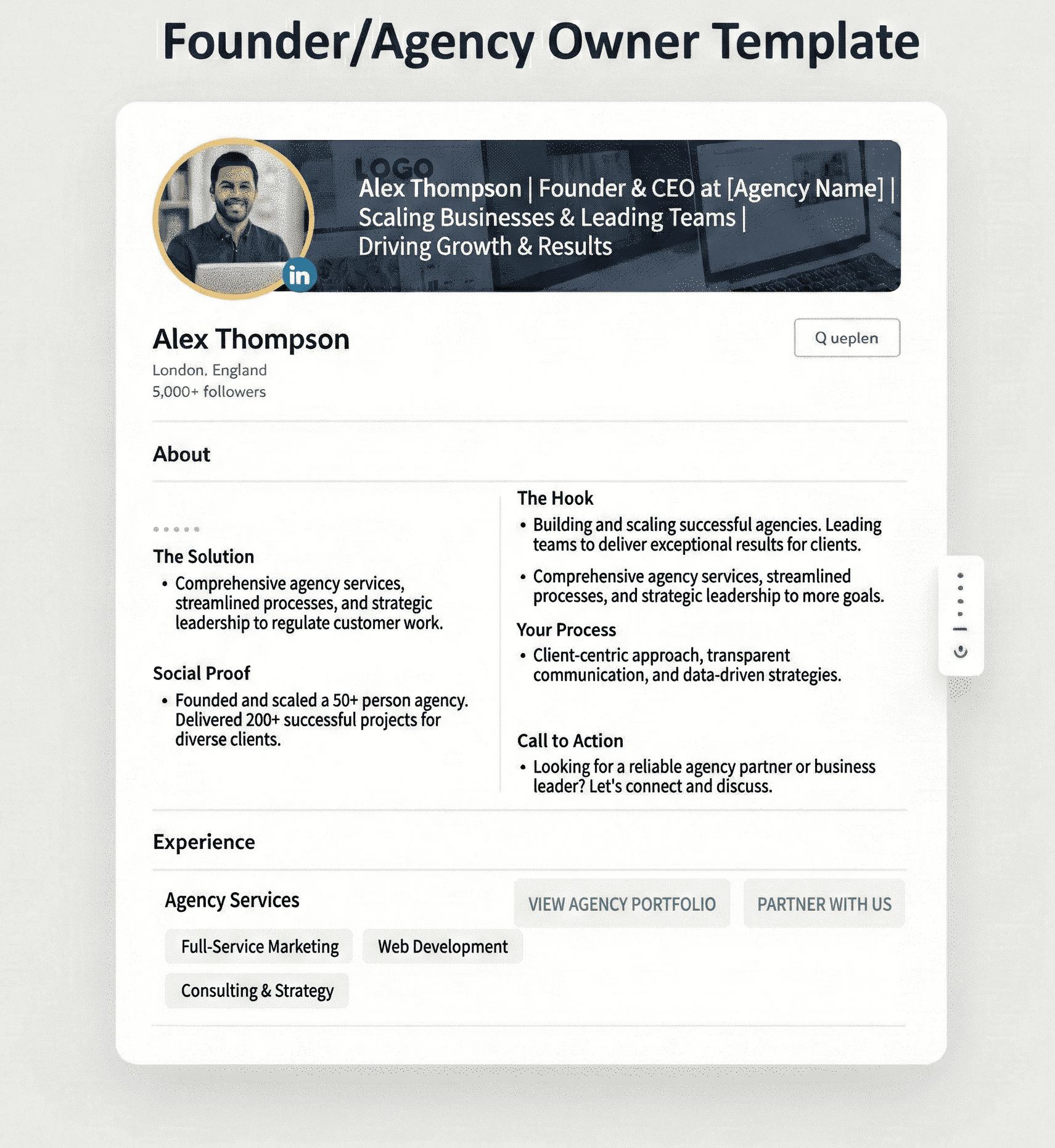
Founder/Agency Owner Template
These templates are generally for agency leaders, business owners, and entrepreneurs who regulate customer work or offer services.
Lead-Focused About Section Template
The following process is mainly ideal for various scenarios for optimising your LinkedIn profile, such as:
- Attracting the ideal audience.
- Guiding visitors to take action.
- Maximizing conversions.

Quick LinkedIn Optimization Checklist Summary
- Clear Positioning above the Fold: You mainly have to ensure that your headline highlights your audience, work, and results.
- Benefit-Driven Headline: Instead of just writing your job title, you have to describe your problem-solving capabilities and the outcomes you can achieve.
- Conversion-Focused about Section: You have to create the first 2-3 lines that can instantly describe capabilities while also focusing on results, not just tasks.
- Optimized Photo and Banner: An optimized banner and photo on your LinkedIn profile can not only indicate professionalism but also create credibility and trust.
- Prospect-Friendly Experience Section: The following section mainly helps with results and business influence, not just responsibilities.
- Strong Social Proof: Having efficient social proof can benefit in several aspects, such as recommendations, endorsements, authority signals, etc.
- Featured Section with CTA: This factor is mainly helpful for highlighting important content, leading with proof, and including a clear CTA.
- Keyword Optimization: There are many procedures for ensuring keyword optimization, for example, focusing on intent, strategic placement, and neglecting keyword stuffing.
- Active and Aligned Content: Posting consistently while aligning with positioning can create active and aligned content.
- Regular Profile Updates: Updating your LinkedIn profile regularly is crucial as it can help in maintaining consistency, especially in engagement rates.
In Conclusion
LinkedIn profile optimization does not just replace content; it opens various paths to engagement, alongside multiplying the content’s results. Furthermore, a well-optimised profile can also work all day, leading mll day. Moreover, you can also start with the profile optimization before measuring outreach or posting.
FAQs
How do you create a lead magnet on LinkedIn?
– If you want to create a lead magnet on LinkedIn, it will mainly require you to provide a consumable, high-value, and specific resource.
How do you define the 4-1-1 rule on LinkedIn?
– The 4-1-1 rule on LinkedIn mainly refers to a tactic that balances promotional content with educational and high-value posts.