


Most of the experts perceive LinkedIn as an electronic filing cabinet, a place to store their resumes and hope that someone stumbles upon them every few years. However, users who manage to utilize LinkedIn are aware that it is not a social media platform, but a search engine. Just like Google or YouTube, LinkedIn uses sophisticated algorithms to construct elaborate profiles and offer users information that suits their purpose. Whether a job recruiter is looking for a “Cloud Architect” or a potential customer is seeking a “B2B Content Strategist,” LinkedIn offers features such as special metadata and activity indicators to identify who appears in its search results and who can be found on page 10. Your LinkedIn profile SEO is not just a brief biography; it’s a data set that the platform’s algorithm needs to understand well in order to increase its ability to discover you through LinkedIn’s search functions.
The challenges associated with the maximization of the presence on LinkedIn are significant, as it is the first location where any decision-maker will turn to in order to learn the sphere of knowledge and work experience of an individual. Being at the top of the search result list does not just put you under consideration as a prospect or service provider; it puts you as a thought leader in what you do!
The recommendations that the algorithm makes are influenced by the mind. Awareness of the search engine features of LinkedIn will enable you to quit browsing the internet passively to locate job opportunities and customers and, rather, actively go in search of the desired talent and customers. In this blog, we will discuss specific methods, tricks, and technology to improve your ranking within the LinkedIn search ranking. So, let’s begin!
Contents
- 1 What Is LinkedIn SEO?
- 2 LinkedIn vs. Google Search Engine SEO: Key Differences
- 3 How the LinkedIn Search Algorithm Works
- 4 LinkedIn SEO Ranking Factors
- 5 Step-By-Step LinkedIn SEO Optimisation Checklist
- 6 How to Find the Right Keywords for LinkedIn SEO
- 7 Common LinkedIn SEO Mistakes
- 8 Advanced LinkedIn SEO Strategies
- 9 How to Measure LinkedIn SEO Performance
- 10 FAQs
- 11 What is the time frame to realize results?
- 12 Conclusion
What Is LinkedIn SEO?
LinkedIn SEO is the act of optimising a LinkedIn profile so that it can be made visible. It can be assisted by using good keywords, putting relevant information on all the sections of a profile based on the requirements of the search engine in terms of a complete profile, and creating social signals that show that you are good, hardworking, and helpful in the job that you are engaged in. LinkedIn SEO is a technical process of personal branding that enables you to build a good brand name with machines.

Take it as Human-Centered SEO Optimization. Although the present goal is to feed the algorithms of Google with data, we are targeting the human beings who might be interested in using or working with us to generate interesting information. The webpage with excellent SEO, yet human traffic is invaluable, as compared to an excellent strategy with the goal of coming up with conversions, without web traffic. Therefore, the LinkedIn search engine strategies should be steered by a compromise of using appropriate keywords and presenting snippet information.
LinkedIn vs. Google Search Engine SEO: Key Differences
The key differences between the two are as follows:
| Characteristic | LinkedIn Search Engine Optimization | Google Search Engine Optimization |
| Significant Objective | Ranking an individual or business website | Ranking a webpage or article |
| Search Intent | Professional networking, B2B services | General tourism, shopping |
| The Rankings of the Speed | Changes are hourly or daily | Months to achieve results |
| Social Signals | One should have a connection and a recommendation | Domain authority and E-E-A-T |
| Keywords Density | High density at selected points | Focus on topic authority |
The algorithm used by LinkedIn reacts to change within a very short duration compared to that of Google. During the search optimisation of the LinkedIn profile today, you can find variations in the amount of your appearance that may be varied numerous times until the week is finished. Nonetheless, the levels of segregations i.e., where you are and the magnitude of your current network, are also far more responsive to LinkedIn compared to Google.
How the LinkedIn Search Algorithm Works
The relevancy engine is a search engine that is linked to LinkedIn and enables users to find each other in terms of their profession. Having entered a search word in the search field, the algorithm will process the database based on three broad categories, i. e., Relevance, Connection, and Completeness. It attempts to identify the profile that can result in an apt professional interaction.
1) Relevance
Does the profile have any specific or similar keywords that are present in the search query? The algorithm goes through the Headline and Job Titles.
2) Connection (Degree)
LinkedIn lays a lot of emphasis on 1st and 2nd degree contacts. Contemporary profiles with identical LinkedIn search engine strategies will rank higher if one of them has an intersection with the web of connections of the searcher.
3) Completeness
An in-depth profile has high-ranking improvements in search. LinkedIn attempts to provide a tremendous user experience, thus concealing an incomplete description profile.
Along with these three measures, there is one more concept that is used by the algorithm of LinkedIn, Profile Velocity. It refers to how many views and contacts the profile has been getting. A popular profile in its own domain can gain greater search results due to the fact that the algorithm will understand that the information on your site is what is necessary and the most recent.
LinkedIn SEO Ranking Factors
To rise in LinkedIn ranking factors, you must be optimised in five major areas.
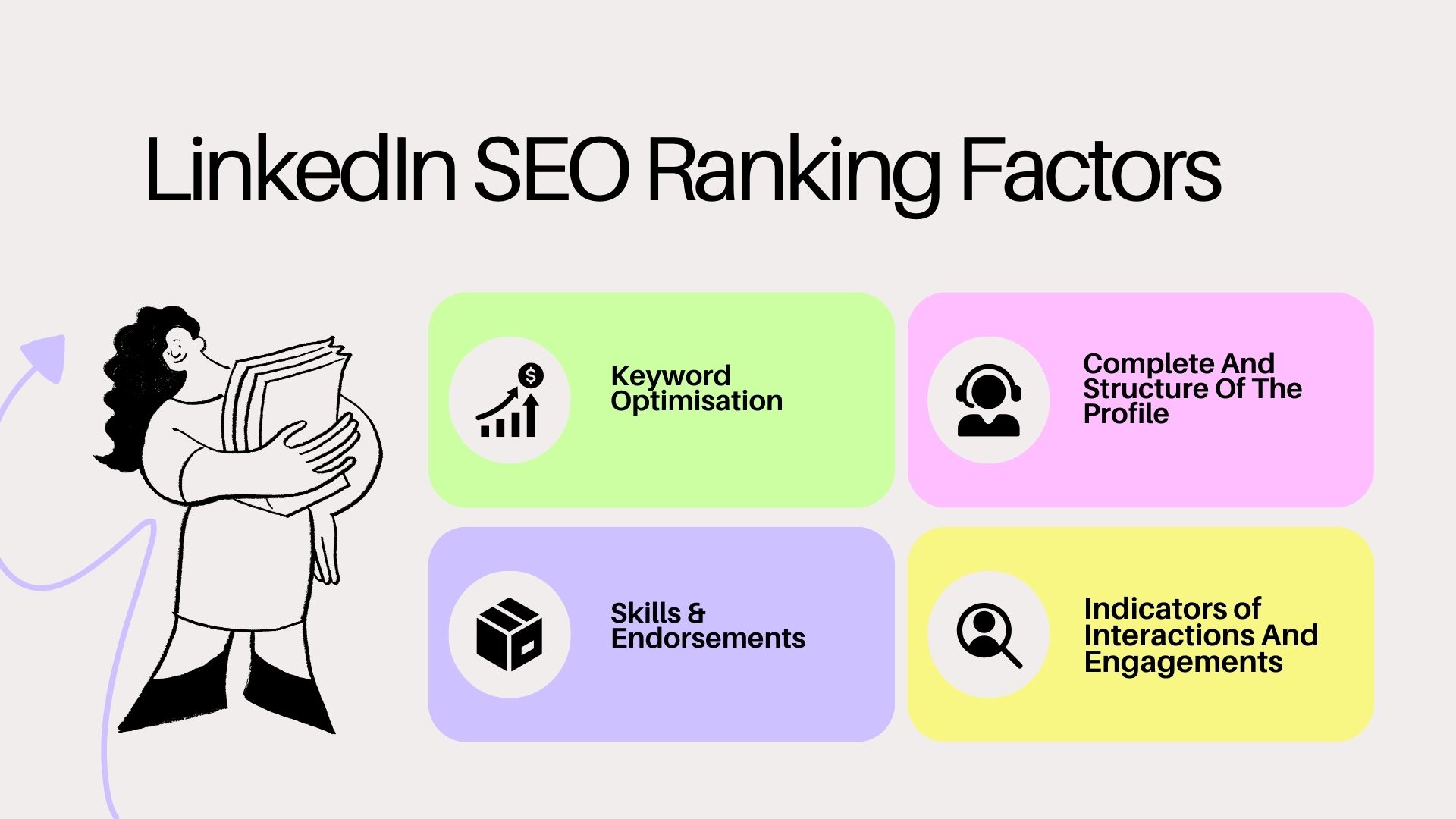
These are as follows:
1. Keyword Optimisation
The keywords are what make us discover. Find the keywords that are searched by your target market (a recruiter, VP of Sales, or any other person) on LinkedIn. When you are an Accountant and your job title is Financial Ninja, it will be difficult to be noticed, as no one searches for the term Ninja when presenting an issue related to taxes. A full-fledged LinkedIn profile optimisation should be created with industry keywords to rank higher in the algorithms, instead of writing creative and baffling notions as headlines.
2. Complete And Structure Of The Profile
LinkedIn is a social media platform that rewards people who utilize it the way it was intended. Full profiles of “All-Stars” consist of a professional photo, an attractive headline, a description of the section, a full educational history, and a list of skills. Missing out on any of these details can result in reducing your LinkedIn search visibility by 20-50%
3. Indicators of Interactions And Engagements
The algorithms give priority to active users, as active users keep engaging with each other on the website. Utilizing LinkedIn to share updates, share industry news, and engage with your network would give the impression to LinkedIn that you have an active profile, and you will be seen by others. Regularly maintaining active engagement creates a sense of “freshness” and keeps your profile at the top of the list.
4. Skills & Endorsements
The skills section is a tag cloud, which is basically a good indexing tool for your LinkedIn profile SEO. Good scores on the LinkedIn endorsement of your core keywords are also one of the good LinkedIn SEO factors. Every skill badge serves as a mini backlink that assists the algorithm to realize that you have the skills that you claim to be the ones that you have.
5. Network Strength
The larger the number of persons that you are connected to, the higher your search buckets throughout the platform. By having more than 500 friends, you have a higher reach through the 2nd degree connection rule. Nonetheless, the number is not everything, as having acquaintances in the industry of your choice, the algorithm will be able to get a better picture of your professional state.
Step-By-Step LinkedIn SEO Optimisation Checklist
With the elements of ranking established, it is high time to move into the real world and have a step-by-step checklist.
Step 1: Identify Your Primary Keyword
Choose a single keyword in which you want to be known (e.g., Project Manager). This should be the term that characterizes your primary business and the most searched term in your business. Once this keyword has been chosen, it must appear in your headline and experience so that a keyword trail can be developed on the crawler. Correlation amongst these parts demonstrates that you are a professional.
Step 2: Optimise Your Headline
The most important field on your LinkedIn profile SEO is your headline, as it is the first thing that will be seen both by the engine and by a human eye.
“Sales Manager at XYZ” is not something that will stand out. Use a formula that is laden with keywords: [Job Title] [Primary Keyword] [Value Prop]. This is a winning formula that will ensure that you hit the hard keyword and will come up with a value proposition that will make the user click through.
Step 3: Optimise Your About Section
It is your sales page and your best opportunity for the long-tail integration of keywords.
- Appeal to the reader with the first two lines by referring to their areas of concern.
- Naturally, use your main keywords and your secondary keywords in the middle of the text.
- Add a list of specialties at the bottom to add in more keywords.
Step 4: Optimise Experience Part
Don’t just list tasks to optimise LinkedIn profile for search. Show proficiency by use of keywords in employment descriptions and titles. If your official title was “Associate,” change it to “Associate Project Manager” to help the algorithm index you correctly. All job descriptions should place focus on the results, with keywords defining that you are proficient with the tools of your trade.
Step 5: Skills Optimisation
List your 3 best skills in the order of preference. They are your high-volume keywords and those you would most like to be advertised with. Shoot to get 20+ endorsements for each. In cases where the algorithm is choosing between two similar profiles, the skills section can often be the determining factor.
Step 6: Increase Activity & Freshness
The minimum number of posts should be twice per week to be considered a high score in terms of activity. Any time you publish or comment, your profile will be updated to the algorithm as new, and this will be more likely to be displayed in new searches. Frequent mobility also sends a message to your future leads that you are on the job and you are working in your line of profession.
How to Find the Right Keywords for LinkedIn SEO
Never assume what is under search; take evidence-based approaches to ensure your LinkedIn search ranking is heading in the right direction to reach the right goals.

Here’s how you can do so:
- Job Descriptions: Find 10 job ads for your dream job. What software and titles are the most widespread? Use those exact phrases.
- Competitor Research: Check out the People also viewed tab of the most popular influencers in your niche. Deconstruct them with their headlines so as to see what keywords they are ranking effectively.
- LinkedIn Search Suggestions: Go to the search engine and type your industry into the search box, and see what it suggests. These auto-suggestions refer to the words that LinkedIn knows its users are currently searching for.
Common LinkedIn SEO Mistakes
Finding the appropriate keywords is one-half of the task; the other half of the task is to avoid the typical pitfalls that ruin numerous profiles. The most widespread errors are the following:
- Using Only Job Titles: Manager is too general and does not have any SEO value. To rank in LinkedIn search, use certain descriptors such as Digital Marketing Manager.
- Keyword Stuffing: It is not smart to write SEO SEO SEO in every single sentence, as it makes one appear written by a robot, and everyone will abandon your profile at once. Write to humans, and then refine to the machine.
- Disregarding the Skills Section: An invisible treasure trove of search indexing that many professionals leave empty. When there are 50 slots, there are 50 different ways to be found.
- No activity: A dead profile will hardly appear on page one since LinkedIn aims at advertising active members of the community. Even some serious remarks per day will help increase your visibility.
- Maximize on Recruiters Rather than Clients: To maximize sales, make sure that you use Solution Provider or Consultant rather than seeking new opportunities. Your profile must appear as a solution and not a request.
- Generic Positioning: Being a Jack of all Trades means you are a Master of none. The algorithm has problems with ranking profiles that attempt to be all things to all people; create a niche and conquer it.
Advanced LinkedIn SEO Strategies
Once you have eliminated the common errors, then you can move on to the next level that makes the difference between the professionals and the amateurs. These include:
Niche Keyword Domination
Instead of competing with Marketing, you should compete with Retention Marketing of Fintech. Competition for a high profit margin in a small pond is far easier than competing in the top 500 in a big pond. This long tail approach will ensure that you get one of the best-qualified leads who are willing to buy.
Creator Mode
To use privileged features like Hashtags of Talks about, go to Creator Mode. This will allow you to have 5 special hashtags on top of your profile, which will be more meta-tags to the search engine. This is among the aspects of the modern LinkedIn search engine optimisation.
Cross-Linking
Include your LinkedIn profile on your personal email signature and personal webpage. This creates external credibility and creates backlinks, which can even make your LinkedIn profile appear on page one of Google. Google considers linking to your LinkedIn with high-authority sites as someone worth considering.
How to Measure LinkedIn SEO Performance
What you do not measure, you cannot control. Thus, you have to monitor your progress via LinkedIn native analytics.

Measure the following every week to determine whether your LinkedIn profile SEO optimisation is working or not:
- Search Appearances: This is what you will see in your profile dashboard. It tells you how many times you have been in a search result. In case this number is rising, then your keyword strategy is performing.
- Profile Views: Who views you? When the individuals looking at your profile are those that belong to your target market, then your LinkedIn SEO strategy is appealing to the right audience.
- Inbound Messages: The final KPI. Do strangers connect with opportunity? This is the real indicator of a high-profile, high-conversion profile.
FAQs
What is the time frame to realize results?
Generally, the index requires a range between 24 and 72 hours to update following a change, although it can require 2-4 weeks of active participation before a major increase in LinkedIn search visibility.
Can I use too many keywords?
No, as this can lead to keyword stuffing. When your profile sounds like a grocery list of technical words, your bounce rate will explode. Target a natural flow in the form of the integration of keywords into interesting stories.
Does having Premium help with ranking?
LinkedIn states that it does not promote search ranking; however, extra insights and Featured Applicant status make you more visible and enhance the click-through rate.
Conclusion
LinkedIn SEO is not a one-time process and is a plan of constant improvement, experimentation, and interaction. When you start thinking of your profile as a website to be discovered as opposed to being provided as a dead resume, you will know that the surrounding world opens to you to the inbound opportunities that would have otherwise been elusive to you in the digital clutter.
The people who actualize the technical why of their visibility will never be left behind in the race, since the platform will continue to transform at their core. Remember: the algorithm is the pathway, but your career story is the treasure that closes the deal. Write to individuals, but streamline to the machine, and you would have the field of your niche.