


Google’s ranking of websites has seen many changes in the last few years. In the past, most website owners focused heavily on keyword rankings, technical tricks, and SEO loopholes to move a notch higher in Google search results. These strategies worked well for a long time. However, Google has now changed its focus to something much more important, i.e., the content.
When the helpful content update was rolled out by Google, it was clearly stated that the content on the websites must be focused on providing value to the visitors rather than the common notion of writing content that appeals to the search engine. Due to the changes in the ranking algorithm, the traffic to many websites has reduced after the helpful content update recovery algorithm.
The positive side of this is that it can be improved upon. In this article, we will explore why many websites are losing traffic after the helpful content updates and what we can do to recover it. Continue reading to have an in-depth analysis!
Contents
What Is the Helpful Content Update?
The Google helpful content update is a site-wide classifier. This system does not just look at the page that contains bad information, but it looks at the overall domain and its vibe and utility. Its main aim is to tell whether a website is producing people-first content that is meant to optimize search traffic to gain an advertising fee.

Google does not want search results filled with articles that fail to address a real problem, offer a new perspective, or provide professional advice. When content lacks originality or usefulness, it does not meet the platform’s quality expectations. If a site simply summarizes what other websites have already said, the helpful content system lowers the visibility of content across the entire site. As a result, even your high-quality pages may struggle to rank because the system considers your website less helpful overall.
Timeline of Helpful Content Updates
To understand how these rollouts affected your site, you should know when they occurred. This helps you identify when changes in your website’s performance or traffic began. The helpful content algorithm has been optimized since Google is always improving to become more user-friendly and more difficult to avoid. The timeline is as follows:
- August 25, 2022: Augmentation of first useful content: English language rollout, adding the system that rewards content created to serve human beings.
- December 5, 2022 – January 12, 2023: Second Update: Became an international update, which covers all languages, with enhanced signals.
- September 14, 2023, to September 28, 2023: Third Update (September HCU): Included an improved classifier to select more unhelpful content, with bigger and more extensive effects on the rankings.
- March 2024: Added to Core System: In March 2024, Google incorporated the Helpful Content System into its core ranking system. As a result, Google no longer releases periodic updates for it. Instead, the system now evaluates content continuously.
The first step towards the recovery of the useful content is monitoring these dates in your analytics. When your traffic chart resembles a cliff in these particular months, there is a high probability that the content strategy of your site will require a radical change to meet the new Google criteria of quality.
Why Most Websites Lost Traffic?
Most creators are upset as they used the old rules and still lost it all. The fact is that the definition of quality transformed as the helpful content algorithm changed it.
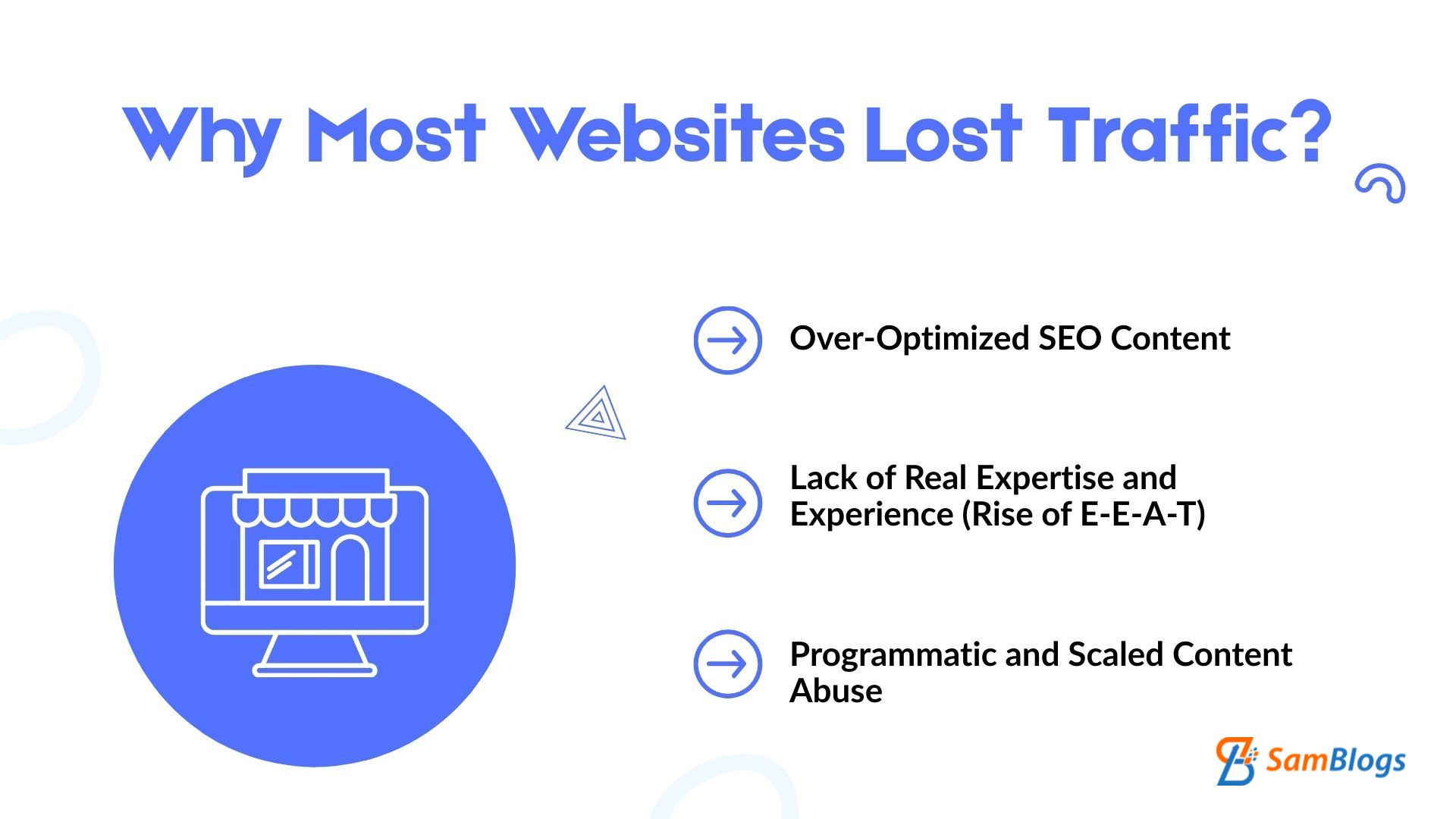
This is the reason why the majority of the sites face SEO traffic loss:
Over-Optimized SEO Content
Gone are the days of bot writing. The repetition of a keyword 15 times in a 500-word post produces a robotic feel, which is not natural to see. Google now recognizes this as over-optimization, which indicates that someone created the page primarily to rank in search results rather than to help users. Effective and helpful SEO content must come across as a two-expert communication, rather than a list of keywords.
Thin and Low-Value Content
Thin content does not simply imply posting brief content, but it refers to the posting of content that does not contribute anything new to the internet. Why do you expect Google to rank you when your article is a replicated version of the three best results on Google? The helpful content system will reward exclusive ideas, original information, and value-added content that is not elsewhere available to users.
Lack of Real Expertise and Experience (Rise of E-E-A-T)
The emphasis of Google on Experience, Expertise, Authoritativeness, and Trust (E-E-A-T) is now a significant ranking factor. Several websites lost traffic because they did not show author entities that prove a real and qualified human wrote the information. Without this, your helpful content update recovery will be nearly impossible.
Programmatic and Scaled Content Abuse
When the AI had gone off, numerous owners of the sites attempted to compete by posting 100 posts per day to win. This scaled content is commonly repetitive, factually empty, and is not a distinct brand voice. The new changes at Google have now become exceedingly effective in identifying such trends and ranking out websites that only focus on quantity rather than quality.
Poor User Experience Signals
Signs Your Website Was Hit by Helpful Content Updates
To spot a hit of the update to the Google helpful content, you have to look at the big picture of your data, not at individual pages. Here’s what it includes:
Sudden Traffic Drop After Update Rollouts
A drastic decrease in organic traffic immediately after a known Google Algorithm Update is one of the most obvious ones. Contrary to slight decreases in traffic due to seasonal factors, the HCU effect tends to be visible by a steep descending curve on the graph. Here’s how it happens:
- Reduction in Clicks and impressions in the Google search engine indicator.
- Traffic decreases as soon as an update rollout is known.
- The fall is not recovered from fast, but is maintained.
- Various pages become out of view simultaneously.
When this happens, it is usually an indication that the Google system has reviewed the usefulness of the content on your site. You can compare your traffic data with official update timelines to confirm whether the helpful content update caused the decline.
Ranking Loss Across Many Pages
The other good signal is the occurrence of multiple pages within the site losing their ranking simultaneously. In contrast to the manual punishments or single isolated SEO problems, the helpful content system measures the quality of content on a domain scale. This includes:
- The articles that were ranked on the first page previously fall to the 2nd or 3rd page.
- Blog posts, product pages, and guides fall out of favor.
- Even the content pages of the high quality lose the rank briefly.
- The visibility of the keywords overall has reduced in the SEO tools.
This is due to the fact that the algorithm might lose faith in the overall quality of content on the site. Consequently, the ranking of several pages may drop at the same time till the site can prove its added value in content.
In most instances, the sites affected by helpful content updates only succeed following enhanced Content Quality SEO throughout the site. The websites can regain trust with the search engines by progressively appealing to users with first content, higher expertise, and actual value to regain organic position.
How to Recover from Helpful Content Updates?
The path to helpful content recovery is quite long, yet it can be accomplished. The only way to almost re-earn the trust of Google is to demonstrate that your site has a purpose, is a real site catering to real people.

Conduct a Full Content Audit
Instead of asking what is ranking, ask what is dragging you down. You must determine zombie pages that do not have any value and either enhance them or delete them. A site that is clean, lean, and has 50 awesome articles is much better to the helpful content penalty algorithm than a site that is bloated and has 500 mediocres.
Focus on People-First Content
Ask yourself: Would I even read this were I to come across it on social media? It is time to quit worrying about the number of words and begin to concentrate on satisfaction. The content in a people-first format must make the reader feel that they have learned something or have a problem solved without having to revert to the search result page to seek further assistance.
Demonstrate Experience and Expertise
Show, don’t just tell. Use the personal experience with the subject: I and we. Incorporate photographs, case studies, or video links that will demonstrate that you are not just paraphrasing others. Developing an effective about us page featuring actual bios is one of the most important aspects of any SEO recovery strategy.
Improve Content Depth and Value
Get more in-depth than your competitors. They give you five tips, and you give them ten and a downloadable checklist or a certain pro-tip depending on your own personal experience. Creating helpful SEO content means being the “final stop” for a user’s search query, providing so much value that they don’t need to look elsewhere.
Reduce Scaled or AI-Only Contents
You need to prune thousands of pages that contain AI-generated information. A human-in-the-loop approach helps support and guide the content recovery process. In spite of the fact that AI does the research work, a human being needs to edit, check the facts, and include personal anecdotes to make the information sound and reliable.
Improve User Experience
An assistant site should be user-friendly. Make sure that your mobile navigation is smooth and your fonts are easy to read. Ensure that your site speed is fast and reliable. You can also improve user experience by removing unnecessary ads that interrupt reading.
The New SEO Strategy After Helpful Content Updates
In order to remain secure in the future, you need to create a moat around your site that can not be easily traversed by algorithms.

This requires a shift from “gaming the system” to “building a brand.” Here’s how you can do it:
Build Topical Authority
Do not attempt to be a jack of all trades. When you write about Organic Gardening, do not immediately begin to write about Cryptocurrency. When you address all the sub-topics in a niche, you will demonstrate to Google that you are a specialized source of information. This is one of the most significant indicators to the helpful content system.
Build Brand Authority
Google would prefer that you are not just the result of the search bar. When individuals look up your brand by name, it is the final indicator of helpfulness. Devote your time to an email mailing list, social following, or placement in authoritative news sources to cement your useful content recovery.
Earn High-Quality Backlinks
The internet links are the currency of the net, yet quality is all. A single link of a large industry publication will be worth a thousand bad directory links. Emphasize digital PR, which is producing content that is insightful and unique to such an extent that it will serve as a source that other professionals will not be able to ignore.
Conclusion
The friendly content update is not a life sentence to your site; it is a call to change. Although it is painful when a traffic decline is observed following the rollouts of helpful content updates, it is a strong indication that your former strategy fails to work any longer. The internet is getting more real, and those who change will ultimately experience the greatest growth at some point.
Focus on creating high-quality SEO content that reflects your practical experience and addresses the real needs of users. By doing this consistently, you can gradually recover and bounce back from the impact of helpful content updates. It may not happen overnight, but a commitment to quality will help your site stand out among millions still relying on outdated SEO methods.
FAQs
Why has my traffic on the site gone down?
A sharp decline typically indicates a technical glitch or a change in the Google algorithm. Look for index bloat (unnecessary pages that are low quality) or canonical conflicts (pages that are confusing the search engine). In the case your drop coincides with a date of a Google helpful content update, then it is likely that your site does not have sufficient people-first content cues.
What is the average duration of the recovery of a useful content update?
It is a slow process. Since the helpful content system is global, it means that Google often waits months for consistent, high-quality content improvements before it starts to lift the ranking suppression on your site. Helpful content recovery usually begins 3-6 months following major improvements in most sites.
Is it still possible to write my blog post with the help of AI?
AI is not a substitute for a writer; it is a tool. You need to incorporate AI in order to collect data. But human assistance is needed to make it helpful for your SEO.
What is the largest error that people commit when engaging in helpful content recovery?
The greatest blunder is surface-level fixing. It is not enough to change some of the titles or to add some pictures. Your strategy needs a radical shift toward experience and expertise.
Is a loss of traffic following a valuable post update indicative of a penalty to my site?
Technically, no. Google does not apply a manual punishment through an individual reviewer; its automated classifier evaluates your content. Your site is not blocked, but the system currently considers it less helpful than other pages. You can reverse this by demonstrating your site’s value through a focused SEO recovery plan.