


Throughout the year, Google launches various updates to ensure user convenience for web browsing and SEO. For instance, you can also refer to the Google Spam update in 2025, which generally focuses on improving the search results. The spam update primarily achieves this by identifying sites that circumvent spam regulations.
Furthermore, the Google Spam update also focuses on decreasing the website’s visibility by participating in various illegitimate activities. For example, there are keyword stuffing, auto-content generation, cloaking, low-quality backlinks, and many more. Additionally, the following generally ensures that users encounter content that is both trustworthy and relevant by automatically eliminating spammy content.
In this article, we will examine several key aspects of the 2025 Google Spam update, including its benefits, drawbacks, and its impact on various industries.
Contents
How Do You Define The Spam Update of Google?
Following our previous mention, you can notice several types of updates released by Google to enhance the user browsing experience. Some of the updates include Google core updates, which announce new guidelines and restrictions for content release, and others are similar to Google spam updates, which ensure content quality.
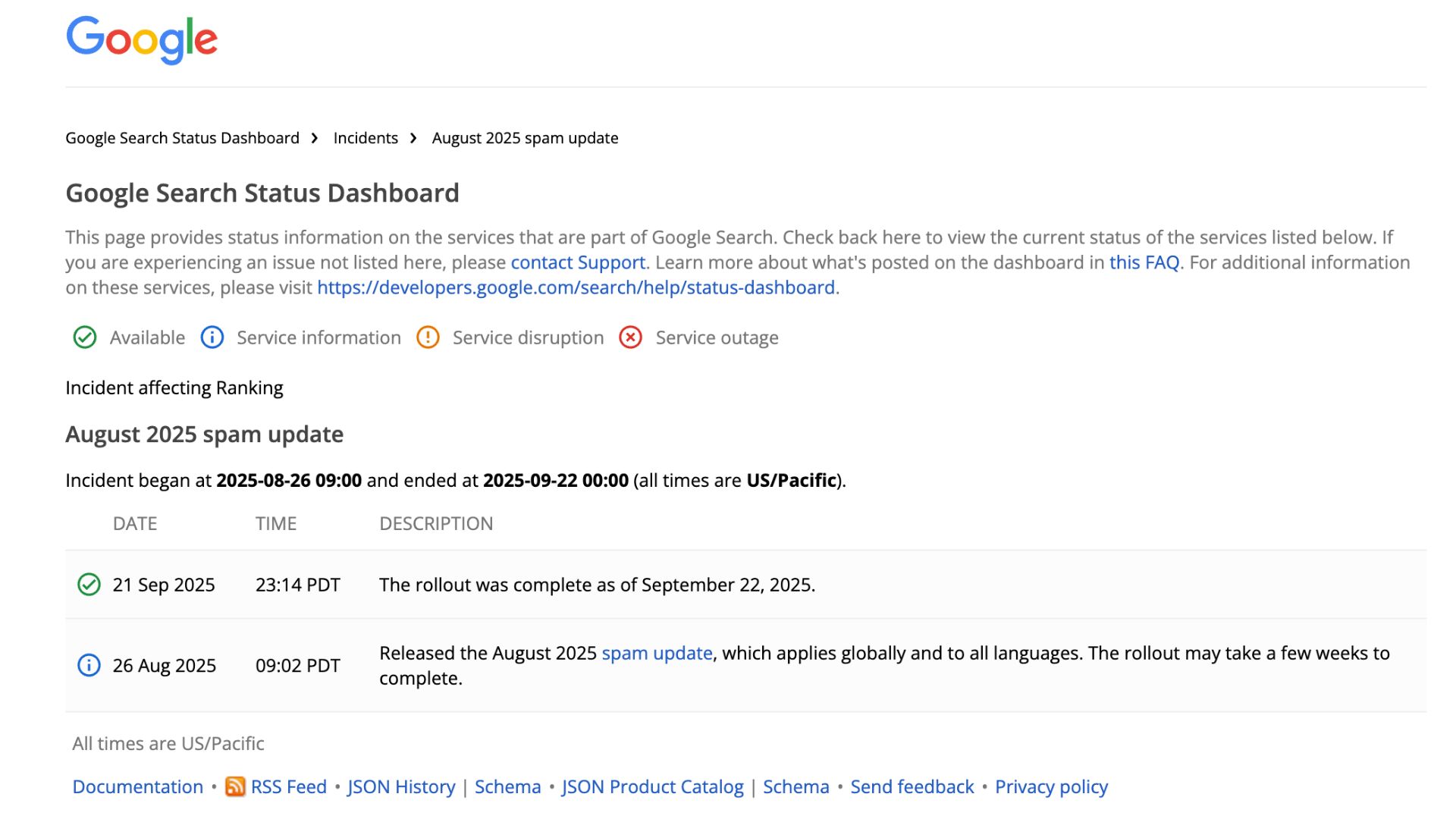
Moreover, when specifically discussing the spam update, it generally refers to detecting sites that promote spam or illegitimate content and removing them from the web. Additionally, at the end of August 2025, Google released its new spam update, which primarily focuses on enforcing existing spam regulations.
Additionally, unlike the core, which is primarily responsible for content ranking, the Google spam update operates differently. For instance, the spam update generally targets low-quality and spammy methods that several websites use to increase their search visibility artificially.
Google began rolling out the update on August 26, 2025, around 12:00 PM ET, and will continue to extend the update for several weeks. However, it has officially completed its extension in 27 days and concluded the update rollout on September 22, 2025. Nonetheless, as the update has an extension period of several days, many websites have reported numerous negative experiences.
For instance, most of the negative experiences are website volatility, uncertain gains and drops in ranking, sudden site restrictions, etc.
Google Spam Update And Other Insights
In August 2025, Google launched one of its pivotal updates aimed at ensuring content quality and removing illegitimate practices that boost site rankings.

Although the update generally promised to enhance user experience on reliable content, there are also other insights we can notice, such as:
Main Focus of The Spam Update
The Google Spam update primarily targeted the spammy and illegitimate activities of several websites. For example, some of the boundaries of these activities include mass-produced webpages, AI-generated content, and thin content, with no human oversight whatsoever.
Moreover, the spam update also targeted several site behaviours. For instance, you can refer to hidden links or text, doorway pages, keyword stuffing, and many other techniques. Alongside these factors, Google has also successfully identified structured data maneuvers where different websites implement schema markup in deceptive ways, with content providing no authentic value.
Instant Effects And Industry Responses
There are several impacts that you can notice from this update, which are both crucial and rapid. For instance, several websites have experienced significant drops in traffic and ranking within the first one or two days. Additionally, while analyzing the previous spam updates, the current update has only penalized spammy websites, rather than naming any legitimate websites or their practices.
Moreover, websites that have received spam updates in 2023 or at the start of 2025 have indicated partial recoveries. This indication suggests that Google is reconsidering the previous restrictions under its updated facilities. Furthermore, individuals in the search engine optimization field have observed increases in indexing delays and decreases in the visibility of their new content in search results.
Directional Insights of Google
The Google Spam core update in August has marked several significant changes in Google’s content procedure. Initially, the update generally promotes the expanding experience of its SpamBrain AI facility. This system can currently identify various kinds of spam, including the repetitive misuse of AI-generated content.
Moreover, as we mentioned earlier, this spam update focuses on various spam practices. For example, you can refer to low-quality backlinks, cloaking, auto-developed content, keyword stuffing, and many more. Additionally, with the Google August spam update, Google primarily aimed to ensure that users generally receive positive content.
For instance, the positive content is trustworthy, helpful, and unique in nature, presenting authentic information from reliable sources across the web.
Wider SEO Takeaways
The broader lesson of the Google Spam update is that search engine optimization should adhere to authentic content practices. It is mainly because Google generally focuses on websites that have different characteristics in their content. For instance, their content is primarily accurate, in-depth, and helpful, rather than relying on shortcuts.
The following procedure primarily identifies various malicious activities and behaviors. For example, they are mirroring content across thousands of webpages, misusing schema markup, and overrelying on AI for quantity over quality, which poses a significant threat to the production of authentic content in the market.
Moreover, the spam update of Google has directly indicated that your search engine optimization procedure should follow several legitimate procedures. For instance, you primarily need to integrate your SEO practices with factors such as editorial tactics, user experience, and content auditing.
Neglected Portion of The Spam Update
Although the Google Spam update in August prioritized several crucial aspects of content quality, it also neglected various significant portions that enhance the user experience. For instance, Google has declared that the following update did not instantly address link spams or website reputation abuses, despite several speculations.
However, it also does not indicate that the following practices are generally safe or legitimate. The update has also clarified that Google has not prioritised this proportion with their recent spam update. Several SEO professionals have identified several factors that may have negative impacts in the future.
For instance, they are primarily comprised of private blog networks, link schemes, guest posting farms, and numerous other tactics.
Google August Spam Update And Its Impact on Different Industries
The primary focus of the Google Spam update was to eliminate malicious practices and spammy websites that promote illegitimate and harmful content.
However, despite its good intentions, the update has both good and bad effects on different markets in the industry, such as:
YMYL (Finance, Health, And Legal) Websites
The Google Spam update has significantly impacted several industries. For instance, you can also refer to the YMYL (Your Money or Your Life) websites, which generally highlight sectors such as commerce, health, and law.
Additionally, we must remember that Google already holds these websites to a high standard due to their potential impact on user well-being. Descriptively, the August Spam update of Google has increased its scrutiny of these websites.
For example, websites that provide content over commercial recommendations, medical data, and legal suggestions will face a drop in their rankings if they fail to mention various authentic factors. Moreover, these factors are basically proper author information, trust signals, and citations.
Local Search Engine Optimization And Local Businesses
The August Spam update from Google has also impacted local businesses and local search engine optimization. Additionally, the impact is more pronounced on websites that have engaged in malicious or spammy search engine optimization tactics.
Furthermore, local businesses that have stuffed keywords into their Google Business Profile (GBP) names, implemented unauthentic reviews, or have developed duplicate pages with multiple locations received the most severe impact from the update.
Furthermore, the spam update mainly resulted in decreases in local search rankings for websites and the service pages. On the other hand, businesses that have authentic Name, Address, and Phone (NAP) information, alongside helpful and unique content regarding their services, and proper consumer reviews have noticed an increase in their online visibility.
Content Publishers, Media, And Blogs
There are various content-rich websites, including news publishers, blogs, and educational portals, that have experienced volatility following the Google Spam update. The main reason these websites or content sources receive a negative impact is due to their heavy reliance on AI-developed or syndicated content.
Moreover, Google has also flagged webpages or websites that publish a large quantity of low-quality content or release guest content without editorial guidelines through their spam filters. Not only have media outlets, but also the public, received negative feedback from this update.
For instance, media platforms that have prioritized clickbait or off-topic content on their webpages have noticed sudden drops in their online visibility and search engine rankings.
Government, Educational, And Non-profit Websites
Although websites that fall under the categories of education, non-profit services, and government activities may seem harmless, they too have undergone several changes in their online visibility. It is mainly those websites that have engaged in various spammy and malicious practices to boost their search ranking.
For instance, some spammy activities, such as implementing outdated or mirrored templates across different webpages and abusing structured data, have been observed to result in a decline in their search ranking. Additionally, sites with content that is generally reliable and trustworthy, as well as those that are less commercially driven, have experienced a positive impact from the Google Spam update.
Search Engine Optimization Agencies And Digital Marketers
The August Spam Update from Google has encouraged SEO organizations and digital marketers to adjust to the new or updated content policy. Several conventional content procedures have become ineffective or spammy following the latest Google Spam update in August.
For instance, some of those conventional procedures are templated content growth, low-quality link acquisition, content spinning, and many more. Additionally, organisations are recently moving towards several factors, including editorial quality regulation, schema validation, ethical link-building procedures, and content audits.
Adjusting to The Google August 2025 Spam Update
The 2025 Google Spam Update is not just another algorithm alteration or minor tweak.
The entire update primarily focuses on reinforcing the platform’s long-standing spam policies and optimizing search result quality. Also, users must adjust to the spam update, and here are some points you can follow:
Assessing Your Website Impact
The initial adjustment to this Google Spam update depends on whether it has affected your website. Additionally, the following procedure can be implemented by observing several key factors in search engine optimization. For instance, you can refer to the decrease in traffic, rankings, impressions, and many other metrics.
Moreover, websites that operate with questionable or malicious content practices, alongside releasing a considerable variety of low-quality content, were particularly vulnerable to this update. In contrast, if you notice a stable or improved performance on your website, it may indicate that your site properly follows Google’s standards.
Managing A Content Quality Audit
Another crucial adjustment for this update is conducting a comprehensive audit of your existing website content. Additionally, you primarily need to optimize or remove webpages, especially those that offer no unique insights, are thin, and repetitive.
Moreover, webpages that heavily rely on unedited AI content or spun text often require revision or rewriting due to various human factors. For instance, they are professional quotes, human input, authentic research, and many more. Furthermore, focus on developing content that highlights different characteristics to improve your search ranking.
For example, these characteristics include expertise, usefulness, and accuracy, while also not focusing solely on Search Engine Optimization keyword preferences.
Optimizing On-Page Signals And Structured Data
As mentioned several times, the update mainly focuses on the abuse of schema markup or structured data. This happens especially when sites misrepresent a webpage’s purpose while inflating its visibility in search engines.
Additionally, you primarily need to review and refine your schema markup to ensure precise visible content reflection, while also adhering to Google’s structured data policies. Moreover, various issues may lead to penalties after the implementation of the Google Spam update.
For instance, they are mainly characterized by over-optimization, fake review stars, FAQs sections, and job postings, among others. Additionally, the latest Google Spam update also encourages users to implement various SEO factors properly. For example, you can refer to titles, meta descriptions, and headings, which should be clear, precise, and relevant to your website visitors.
Re-evaluating Website Authority And Link Building
Although the August 2025 spam update did not directly focus on link spamming, it becomes clear that manipulative backlinks alongside low-quality accounts remain a significant risk. However, after the current update, it is essential to audit your backlinks.
Moreover, to acquire genuine links for your site, you mainly need to avoid paid guest post farms and steer clear of toxic links. Additionally, you should also focus on gaining proper backlinks through authentic relationships, editorial mentions, and Digital PR. Furthermore, Google actively rewards authentic link acquisitions driven by real-world authority and high-quality content.
Improving Industry-Driven And Local Content
For industry-driven and local business websites, it is crucial to craft your responses through your website in your focused category. For instance, local businesses should refine their Google Business Profiles (GBP), remove spammy strategies such as keyword stuffing in names, and focus on key factors that matter.
Moreover, they are mainly authentic reviews, location-based content, precise service data, and much more. Additionally, for websites that focus on various sectors, such as health, commerce, and legal niches, you should invest in different facilities. For example, they are expert-oriented content, disclose qualifications alongside including author information with relevant experience.
A Long-Standing SEO Mindset
The primary focus and adjustment of Google Spam update in 2025 generally leans towards a value-oriented and sustainable SEO practice. Additionally, Google updates are actively identifying patterns of spammy activities and data manipulation, regardless of the technical expertise involved.
Moreover, the following process highlights several factors, such as mass automation, shortcuts, and excessive optimization, which will become less significant over time. For a proper SEO adjustment, your long-term growth or strategy depends on various factors.
For example, you can refer to tactical content planning, technical health, transparent SEO procedures, user experience, and many other key areas. You should also consider creating content calendars, aligning with authentic audience questions, and repeatedly updating previous posts to reflect new data.
Negative Impacts of Google Spam Update 2025
Although the current spam update of Google harbours several benefits for ensuring content quality, you can also notice various impacts that you can experience from this update, such as:
Notable Decrease in Organic Rankings And Traffic
A significant drop in organic ranking and traffic is one of the most noticeable downsides of the Google Spam update. Several users have reported that after the update was released, they noticed a significant decline in their website ranking due to Google’s spam policies being violated. Additionally, statistics have shown a decrease of 30 to 70 percent in organic traffic immediately after the implementation of this update.
Loss of Structured Data Benefits And Rich Snippets
Several websites misuse the structured data markup scheme. For instance, you can refer to exaggerated FAQ sections, fake reviews, imprecise schema tags, and many more. Moreover, websites that primarily follow these procedures will no longer have their listings displayed as FAQs, review stars, or featured snippets.
De-Indexing of Low-quality And Spammy Pages
In many cases, numerous websites have experienced de-indexing of specific webpages or complete sections that Google has already labeled as spammy. Additionally, Google’s spam-detection system has begun filtering content of low quality, particularly webpages that utilize AI-generated or duplicated content without originality.
In Conclusion
The Google spam update is enforcing the company’s ongoing commitment to maintaining high-quality search results. Moreover, it primarily achieves this by identifying spammy and illegitimate content while ensuring high-quality content among users. Furthermore, the update also serves as a potent reminder that justifiable search performance relies on following high-quality and ethical SEO practices.