

LinkedIn’s professional visibility is determined by the AI systems now. The search is no longer achieved on the basis of links. It is based on institutional power indications.
You are going to need to design your profile in the case of having even greater AI visibility on LinkedIn. Optimization of the LinkedIn profile as a means of being optimized by AI and possessing long-term authority is also involved in this observation guide.
{
“@context”: “https://schema.org”,
“@type”: “ItemList”,
“name”: “Contents”,
“itemListElement”: [
{
“@type”: “ListItem”,
“position”: 1,
“name”: “What Are AI Citations And Why Do They Matter?”,
“url”: “https://samblogs.com/how-to-structure-your-linkedin-profile-for-ai-citations/#ai-citations”
},
{
“@type”: “ListItem”,
“position”: 2,
“name”: “Understanding How AI Reads LinkedIn Profiles”,
“url”: “https://samblogs.com/how-to-structure-your-linkedin-profile-for-ai-citations/#ai-reads-linkedin”
},
{
“@type”: “ListItem”,
“position”: 3,
“name”: “Optimize Your LinkedIn Headline for AI Discovery”,
“url”: “https://samblogs.com/how-to-structure-your-linkedin-profile-for-ai-citations/#linkedin-headline-ai”
},
{
“@type”: “ListItem”,
“position”: 4,
“name”: “Crafting an AI-Friendly LinkedIn About Section”,
“url”: “https://samblogs.com/how-to-structure-your-linkedin-profile-for-ai-citations/#linkedin-about-ai”
},
{
“@type”: “ListItem”,
“position”: 5,
“name”: “Structuring the Experience Section for Authority Signals”,
“url”: “https://samblogs.com/how-to-structure-your-linkedin-profile-for-ai-citations/#experience-authority”
},
{
“@type”: “ListItem”,
“position”: 6,
“name”: “Skills Section Optimization for AI Recognition”,
“url”: “https://samblogs.com/how-to-structure-your-linkedin-profile-for-ai-citations/#skills-ai”
},
{
“@type”: “ListItem”,
“position”: 7,
“name”: “Using the Featured Section to Strengthen AI Signals”,
“url”: “https://samblogs.com/how-to-structure-your-linkedin-profile-for-ai-citations/#featured-ai”
},
{
“@type”: “ListItem”,
“position”: 8,
“name”: “Consistency Across Platforms for Stronger AI Citations”,
“url”: “https://samblogs.com/how-to-structure-your-linkedin-profile-for-ai-citations/#consistency-ai”
},
{
“@type”: “ListItem”,
“position”: 9,
“name”: “Leveraging Content Strategy for AI Visibility”,
“url”: “https://samblogs.com/how-to-structure-your-linkedin-profile-for-ai-citations/#content-strategy-ai”
},
{
“@type”: “ListItem”,
“position”: 10,
“name”: “Common Mistakes That Prevent AI Citations”,
“url”: “https://samblogs.com/how-to-structure-your-linkedin-profile-for-ai-citations/#ai-citation-mistakes”
},
{
“@type”: “ListItem”,
“position”: 11,
“name”: “Advanced Tips for AI Citation Optimization”,
“url”: “https://samblogs.com/how-to-structure-your-linkedin-profile-for-ai-citations/#advanced-ai-citations”
},
{
“@type”: “ListItem”,
“position”: 12,
“name”: “Future of AI Citations and Personal Branding”,
“url”: “https://samblogs.com/how-to-structure-your-linkedin-profile-for-ai-citations/#future-ai-citations”
},
{
“@type”: “ListItem”,
“position”: 13,
“name”: “Conclusion”,
“url”: “https://samblogs.com/how-to-structure-your-linkedin-profile-for-ai-citations/#conclusion”
},
{
“@type”: “ListItem”,
“position”: 14,
“name”: “FAQs”,
“url”: “https://samblogs.com/how-to-structure-your-linkedin-profile-for-ai-citations/#faqs”
}
]
}
Contents
- 1 What Are AI Citations And Why Do They Matter?
- 2 Understanding How AI Reads LinkedIn Profiles
- 3 Optimize Your LinkedIn Headline for AI Discovery
- 4 Crafting an AI-Friendly LinkedIn About Section
- 5 Structuring the Experience Section for Authority Signals
- 6 Skills Section Optimization for AI Recognition
- 7 Using the Featured Section to Strengthen AI Signals
- 8 Consistency Across Platforms for Stronger AI Citations
- 9 Leveraging Content Strategy for AI Visibility
- 10 Common Mistakes That Prevent AI Citations
- 11 Advanced Tips for AI Citation Optimization
- 12 Future of AI Citations and Personal Branding
- 13 Conclusion
- 14 FAQs
What Are AI Citations And Why Do They Matter?
The citations to the AI are categorized by cases in which the AI system addressed a professional, and the professional answered it. The condensed knowledge could not be in the form of links but sources.
Formatted indicators are used to identify expertise in the system, like ChatGPT and Google. These read association relationship connections, topical consistency, and contextual authority.

The paid backlinks were done via classical SEO. AI visibility on LinkedIn is pegged on visibility and collectiveness. AI pairs your name to the theme given that your LinkedIn profile plan of AI has been pinned to a specific industry theme.
The inspiration for personal branding of AI search is found there. It also fortifies LinkedIn cues, insofar as power in the answer engines is concerned.
Understanding How AI Reads LinkedIn Profiles
The LinkedIn profiles serve as data environments in the AI systems. They instigate objects, specify connections, and cluster like concepts.
It is anchored based on the establishment of entities. The reference to such justified enterprises as Microsoft or HubSpot in the profile brings your identity into the existing knowledge graphs. This mapping is more prominent regarding job titles. Ambiguous labels weaken it.
Keywords will not be placed aside, but depth is even more critical. The power of topical narrative is addressed in AI on a case-by-case basis. It is a comparison of what you have written as your headline, About section, experience, and what interests you, and what you have published. Having these components built on the same beam of expertise, AI validates the situation trust.
Based on context clustering, additional visibility is built. The ideas of the industry were clustered by the AI groups. An example of such is Crawl optimization, schema, site architecture, and Core Web Vitals, which are examples related to technical SEO. Such ideas would constitute a powerful information foundation when coupled with relational information within the context of your profile, frequently. Said is deceived through the use of false random buzzwords.
Application of repetitions with variations is another way through which AI relates the profiles with industries. B2B SaaS and organic growth systems and analytics frameworks would imply that when you mention it 3 times or more in your profile. Then, AI would show it as a correlation to your name. Familiarity is brought about by togetherness. Fragmentation dissolves it.
Optimize Your LinkedIn Headline for AI Discovery
One of the largest category signals used is your LinkedIn title. Before the more detailed profile sections, AISSs study it. It defines the way the models categorize your professional self into clusters of industries. Connection is not made, and there is a poor connection formed by a vaguely written headline. An organized headline develops the signposts of power.
This is not the ambition that AI is deciphering. Artificial intelligence will not place you in a specific area of knowledge in situations where your title is not narrow. This sort of suspicion defiles LinkedIn authority signifiers and restricts the AI oracle LinkedIn possibility. It is also done through clear labeling so as to eliminate ambiguity and enhance classification.
Begin with a speculation of professional self. Establish the main brand. Rather than this abstract text, such as Helping Brands Grow, simply make the title effective and prove what you are.
These are systematic settings that are offered in the headings, which include Technical SEO Strategist and Performance Marketing Analyst. These keywords standardize LinkedIn profiles to search with the assistance of AI, since it is described to clarify industry data sets that can be conveniently assessed.
Have an industry qualifier on a major basis. Industry contextual limitations exist as far as the professional environment is concerned. AI links industry tags to knowledge graphs, and this may empower LinkedIn profile mining to the power of AI.
Technical SEO and Content
One specialization is to be supplemented, and the role and industry should be established. The coordination of the technical SEO and the Content Systems is an indicator of a deep approach and implementation. LinkedIn can work on this stratum, forming an intelligent cluster of expertise.
These generic titles, such as Consultant, Entrepreneur, Advisor, or Visionary, are, as a rule, to be avoided being brought up out of context. These are just labels that do not entail much classification. Labeling of the semantic barriers intensifies and sharpens categorization.
Conversely, at the B2B SaaS SEO Strategist Technical SEO and Content Systems, the industry, position, and specialization of any job are designated in a single row. The intelligibility assists AIin conductingt the projection of your identity to a running thematic group.
Over time, the process of updating this well-planned signpost on your profile gives LinkedIn powerful signals. Serial positioning enhances the likelihood of a greater AI perception of LinkedIn.
What you do not want is to make your headline something impressive. It should aim to classify. Findability is created as a result of categorisation. The shape of height constitutes the AI authority over time.
Crafting an AI-Friendly LinkedIn About Section
Your sub-book on building ought to accumulate authority. An inspirational biography is never a thing to write. Write a topical framework.
Dissection of contents depending on the emphasis in paragraphs. The key professional areas need to be present in every paragraph. To illustrate themselves, a paragraph could be devoted to the explanation of the technical systems of SEO. The other has to do with content architecture. Third may inform on the integration of analytics.
Make sure that you deal with industry terminologies. General statements should be substituted with situational statements. Noble it with a high site traffic to a high site traffic. The artificial intelligence refers to LinkedIn.
Enter the keywords in the explanation sentences, and this must not be artificial. Never read out the phrases in a robot kind of way. Unnatural trends in densities are detected by AI. The optimization of a LinkedIn profile can be optimized in such a way, utilizing Semantic variation to support search using AI.
Short in paragraph form and wide spaced. Organized extraction can be better developed through readability. Obedience to project guidelines will give the AI models the meaning of boundaries in sections.
Most important of all is whether you have an About site adjacent to your headline. The decline in LinkedIn’s power is a result of the indecency.
Structuring the Experience Section for Authority Signals
The evidence of knowledge assertion lies in the experience section. This is a very substantial and convincing component that AI develops.
Define roles clearly. As the Technical SEO Lead, take significant roles, characterize them, and express them in everyday terms. Audit, crawl optimization, schema implementation, and frameworks reporting. Use words as per what you have in your About.
Entreprepared actual outlay in both positions. The credibility indicators would be in the form of figures. Increases in the quantity of the development of the state percentage, increase in the revenue, efficiency gains, or a leap in leads. That is the realization of computers that increases AI visibility in LinkedIn data points.
Apply industry-pertinent tools and frameworks where there is a requirement. Google Search Console, GA4, CRM integrations, or analytics dashboard are some examples. The identified terms link entity mapping.
Seize actual evidence, where there is some. Such as interviews, articles, or case studies to reveal competence. The external validation is linked to AI.
It is not necessary to lay aside the duties that do not produce outcomes. The lists of duties are not situational. The government is expected to be in display of power.
Skills Section Optimization for AI Recognition
One of the classifications is the Skills layer. It is scanned by AI in order to define the consistency of organizing it.
Choose competencies in the form of a niche that can be integrated into the cluster of your competency. As an example, take the Technical SEO, the Schema Markup, the SERP Analysis, or the Content Architecture when you are concerned about search strategy. It is rather a grouping made by such words.
Examples of such generalizations are Leadership or Communication. In those words, it is less differentiated. They make LinkedIn portfolios weak. Make sure that your abilities are in line with what you have posted in your profile. And to ensure that you do not continue posting that you converted rate optimization and are inconsistent in CRO. AI ensures that something is wrong.
LinkedIn power cues are enhanced by coherence. Quality should be a first and not the last priority. The mastery of dexterity enhances AI-reading.
Using the Featured Section to Strengthen AI Signals
The Featured part must be semi-organized evidence-docking. It gives facts of factual authority.
The case studies possessing measurable results should be uploaded in detail. The systematic accounts depict the success of the expertise. Long-form content is a formal type of content that is interpreted by AI.
Inclusions of guest posts or blogs you have posted. Bylines are also correlated, which makes entity recognition more successful.
Share Research papers, white papers, or long-format reports where necessary. The search capacity of AI enhances personal branding as per the content upheld by the research.
One of these is media appearances and media interviews whenever possible. The contextual credibility is the credibility of the publications.
This is one of the points that you cannot leave unanswered. It has a direct impact on the AI visibility of LinkedIn.
Consistency Across Platforms for Stronger AI Citations
AI aligns face recognition on the online platforms. The absence of conformity is a put-down to recognition.
Put your bio on your LinkedIn and site, OMForbid replacement role identity description. One should always use a brand and personal name.
Organize profiles in reserving blogs and guest posts. The unity in developing a background has been substituted with repetition.
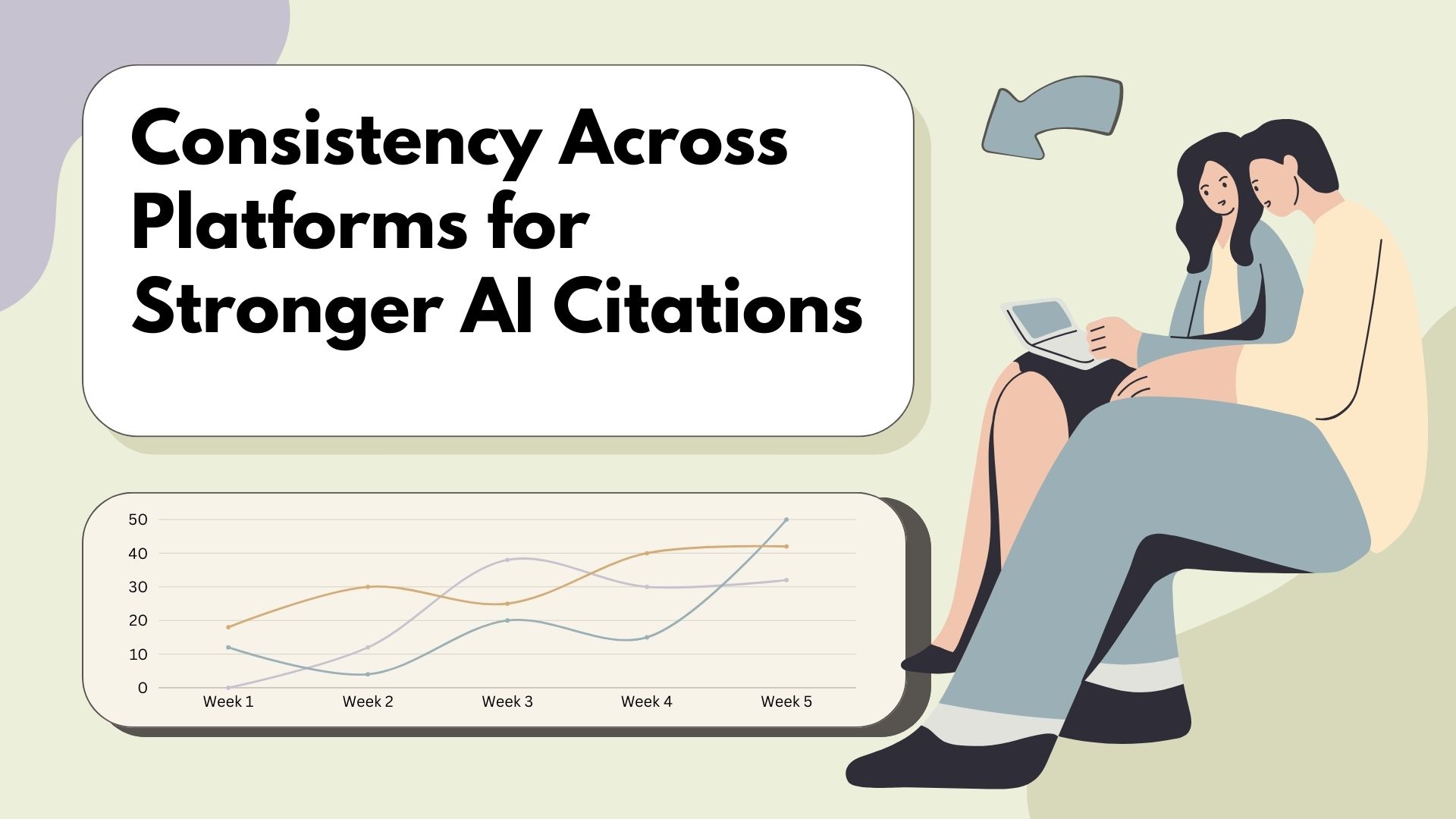
It is not necessary to change professional identities more than once, unless it is a strategic move. Position fusion develops LinkedIn’s strength in appearing on the search results of AI.
AI visibility LinkedIn strategy is based on brand consistency.
Leveraging Content Strategy for AI Visibility
Content publishing helps to make power cliques stronger. Posts on LinkedIn help in the topical reinforcement.
Site architecture, indexing, schema, analogy, and other conversations ought to be written in a regularly occurring fashion as well. You should be a professional with regard to the SEO systems. Post thematic repetitions are determined by AI.
Periodically post long-form posts in the industry. Experience is shown in depth. Artificial intelligence is related to long-term analysis and strength.
Actually, there are more indications given with articles than brief updates. Participate actively in the Industry discussions. Think provocatively about the niche areas. The situation analysis can be employed to draw individuals to your fields of interest.
The active content and quality will generate the indicators of authority at LinkedIn with reference to AI in the longrun.
Common Mistakes That Prevent AI Citations
Credibility is killed by the overuse of keywords. A repetition lacks the context of a means of manipulation. AI distrusted unnatural patterns of density.
Fuzzy positioning distorts clustering systems. AI can never classify experience when you have an unrelated industry on your profile.
Authority is divided through weak branding on various platforms. Single-handed messaging globally.
The absence of systematic attainments erodes trust. Evidence cannot be lacking in power.
A vacant Featured is one of the high-impact real estate wastes. Use it intentionally. These two are the mistakes that minimize the likelihood of ChatGPT quoting a LinkedIn profile.
Advanced Tips for AI Citation Optimization
Added credentials are allowed to be written in your resume. Mark certifies one and another. Entity mapping is getting better in an orderly naming.
Whenever possible, refer to established brands or to established customers. There are also established organizations that make contextual networks better.
Utilize industry Acronym. The acronyms used, such as SEO, CRO, SaaS, and B2B, ought to be displayed in the form of explanation sentences. Use of internal jargon must not be made without decoding it by the AI.
One day, become an opinion leader. Regular publication should be the case in your area of specialization. Occupy is not to be interrupted by other unrelated industries. Power is enhanced with time.
Effective AI LinkedIn profile optimization is created bearing in mind long-term clarity, rather than some of the short-term tricks.
Future of AI Citations and Personal Branding
The workplaces in the sphere of AI answer engines are acquired more and more. The users are demanding to be provided with the condensed expert knowledge instead of links in a list form.
Authority is an indicator that is replacing the traditional backlinks. One of its applications is known as a structured profile as an identity center of AI.
LinkedIn shall remain updated as one of the simple professional authority tools. LinkedIn will create coherent clusters of expertise that will rule the AI visibility.
This means that the professionals within contemporary society have the ability to develop profiles in a strategic style.
Conclusion
Coherence is desired in artificial intelligence. Structure builds authority. Make your LinkedIn profile design.
The targeted increased visibility of the AI and professional accountability in the long term contributes to positioning itself dedicatedly. It also contributes to quantifiable outcomes, and, as a routine concern, the competence.
FAQs
How much is the optimization of LinkedIn profiles to AI worth?
Simple consistency. Structured consistency will be tested using artificial intelligence on your profile. The contextual clustering is enhanced by role descriptions, measurable achievements, and congruent capabilities.
Do LinkedIn profiles have a relationship with AI tools?
AI models uncover structured data, which is publicly accessible. The LinkedIn profile may have magnificent topical authority. In this case, AI may mediate or summarize information about your name under the topics of knowledge.
What aspects of AI visibility do you believe affect LinkedIn most of all?
The headline and the About, Experience, Skills, and Featured signals are outstanding. These areas are compared with the help of AI to the language consistency. The orderliness in managing performance and quantifiable performance enhances prudence.
Is the AI authority correlated with the quantity of the postings done?
Yes. The theme clusters are backed by the thematic clusters owing to the regularity of publishing. The duration of the posts exposes how profound the topic is. LinkedIn profiles will be streamlined as far as search is concerned in the long run.
What is the probability of proving the presence of strong AI citations on LinkedIn?
The experience of power is also a calculated experience. All these are formulated positioning, accord of terms, and quantifiable success, which builds strength through depth. Intensive publications accelerate the topical clustering.
{
“@context”: “https://schema.org”,
“@type”: “FAQPage”,
“mainEntity”: [
{
“@type”: “Question”,
“name”: “How much is the optimization of LinkedIn profiles to AI worth?”,
“acceptedAnswer”: {
“@type”: “Answer”,
“text”: “Optimizing LinkedIn profiles for AI helps improve structured consistency. AI systems evaluate role descriptions, measurable achievements, and skill alignment to strengthen contextual clustering and topical authority.”
}
},
{
“@type”: “Question”,
“name”: “Do LinkedIn profiles have a relationship with AI tools?”,
“acceptedAnswer”: {
“@type”: “Answer”,
“text”: “Yes. AI models analyze publicly available structured data from LinkedIn profiles to understand topical authority and expertise. This information may be summarized or cited by AI systems when discussing professionals or industry topics.”
}
},
{
“@type”: “Question”,
“name”: “What aspects of AI visibility affect LinkedIn the most?”,
“acceptedAnswer”: {
“@type”: “Answer”,
“text”: “Headline, About section, Experience, Skills, and Featured sections are the most important. AI systems compare language consistency and measurable achievements across these sections to evaluate authority and expertise.”
}
},
{
“@type”: “Question”,
“name”: “Is AI authority correlated with the quantity of postings?”,
“acceptedAnswer”: {
“@type”: “Answer”,
“text”: “Yes. Consistent publishing supports thematic clusters around specific topics. Over time, regular posting helps demonstrate deeper topical expertise and improves visibility in AI-driven discovery systems.”
}
},
{
“@type”: “Question”,
“name”: “What indicates strong AI citations on LinkedIn?”,
“acceptedAnswer”: {
“@type”: “Answer”,
“text”: “Strong AI citations are supported by structured positioning, consistent terminology, measurable achievements, and deep topical publishing. These signals help AI systems identify authority and credibility.”
}
}
]
}