

Contents
About Labrika
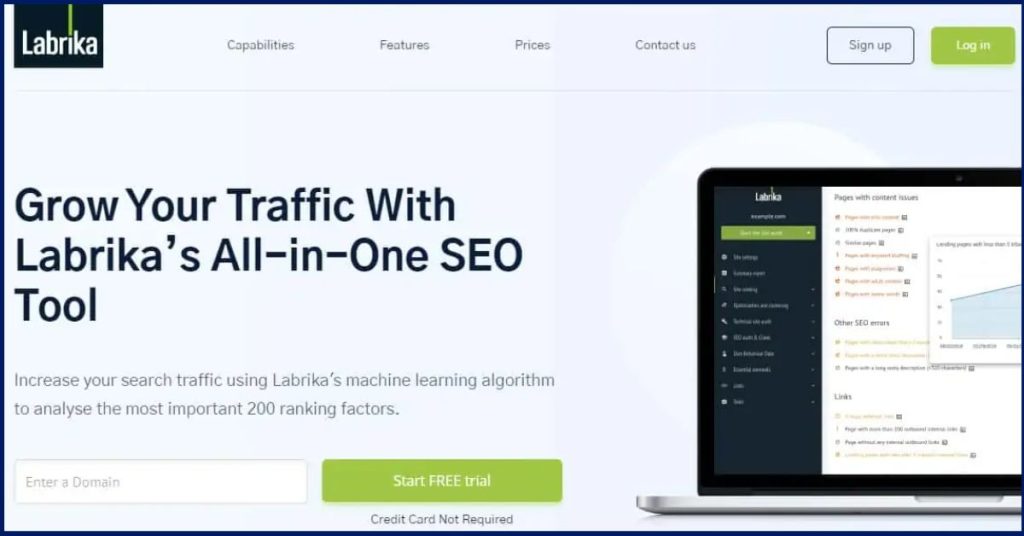
Labrika is touted as an all-in-one SEO tool that employs a machine-learning algorithm and assesses key search engine ranking indicators to propel your website to the top page of results.
In a nutshell, it determines what is wrong with your website and provides options to correct it.
With the competitive nature of search engine ranking, it’s definitely beneficial for a business to have a tool that can assist in discovering and fixing problems.
However, SEO is a complex digital strategy. There might be hundreds of reasons why your website is or is not ranking well.
And finding such data takes a long time. So that’s what Labrika attempts to figure out.
It saves time and delivers actionable data, both of which are necessary for ranking on Google.
Features of Labrika
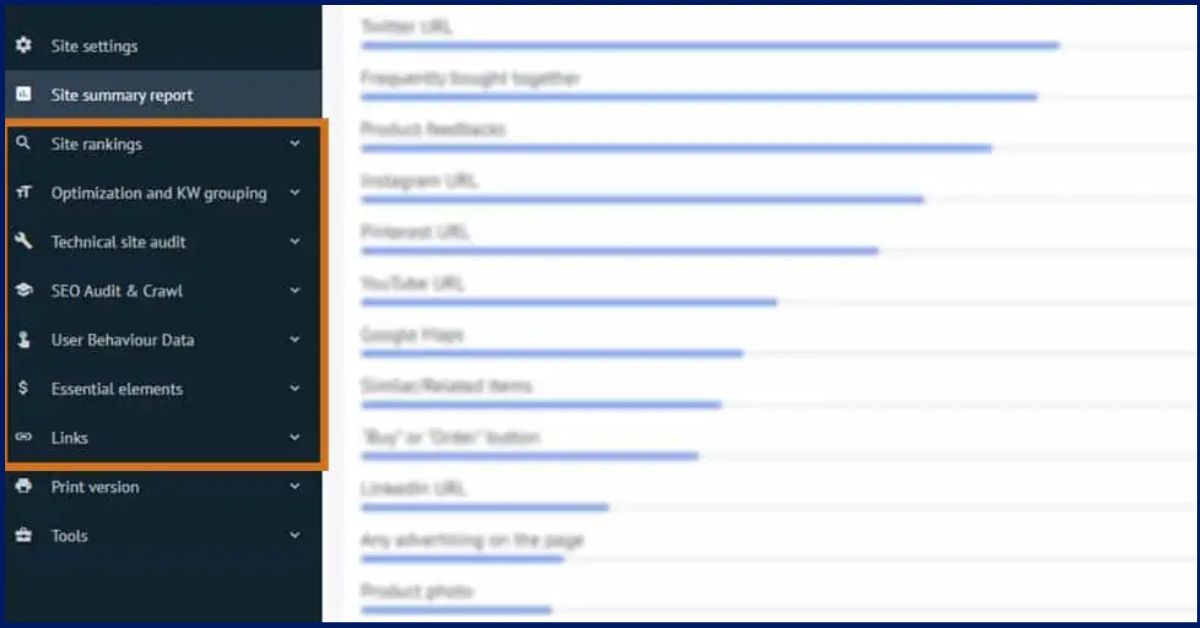
Labrika is split up into seven major elements, each of which addresses a specific SEO goal.
- Rankings of Websites
- Keyword Grouping and Optimization
- Technical Site Inspection
- Crawl & SEO Audit
- Data on User Behavior
- Elements That Are Considered necessary (Competitor Analysis)
- Links
Labrika Is Versatile, But Do You Really Need All of Them?
There are several SEO tools that claim to accomplish everything; yet, each of these tools has unique qualities that make it stand out from the crowd. Other features may be useful, but you are unlikely to utilize them.
In this Labrika review, I’d want to concentrate on areas where I trust Labrika will directly help in optimizing content for Search rankings.
Optimization Keyword Grouping and Full Website Audit are two aspects that stuck out to me.
Another notable benefit is Links, which may be really useful.
That being stated, I’ll go through each of these three aspects and how SEO professionals, authors, and website owners may use them.
Let’s have a look at what Labrika has to offer.
Full Website Audit
The extensive website assessment includes both SEO and technical site auditing.
A thorough audit of the site is always necessary to determine the website’s health. This section will inform you what’s wrong with your site, which issues need to be addressed first, and which parts are in excellent condition.
I’ve used a number of SEO audit tools in the past, so seeing Labrika’s dashboard is a pleasant variation.
Labrika’s user interface is simple, so I can tell where I need to go at a look. All that’s left for me to do is enter the domain I’ll be auditing and other pertinent information so Labrika can get to work.

Commence Auditing
It will inquire as to the type of report you wish to process. I’d recommend performing a thorough website analysis so you can acquire everything you need all at once.
It should be noted that Labrika only displays data from Google and not from other search engines, which is unfortunate if you want to optimize for other search engines such as Bing and Yahoo.
What I appreciate about their search audit is that you may specify your website’s target area, city, or state in addition to your target nation. This is really beneficial when attempting to rank a local business.
The SEO Audit and Crawl part examines content optimization factors such as meta tags, plagiarism, content quality, and competition list.
Labrika took around 10 minutes to complete the result and provide the entire website analysis. That’s a long time to wait, considering the website I uploaded is quite young, with just over 50 published pages.
While the wait time is reasonable when compared to SERPstat, it is not as quick as SEMrush or Ahrefs. However, this may vary depending on the size of your website.
Technical data such as errors, broken pictures, duplicate pages, sitemaps, page speed, and canonicals are checked for during the technical audit.
Content Optimizer
- Labrika includes a content editor, enabling you to immediately modify and alter your material based on Labrika’s optimization.
- The editor highlights words in three different colors to indicate whether they are excellent, contain mistakes, or need to be improved.
- Since the results are real-time, you can simply copy and paste the final material to your site once you’ve finished implementing recommendations and are pleased with the ratings.
- You may also provide your writer with a personalized URL so that they can immediately modify and optimize the information.
The content optimization tool has swiftly become one of my favorites. What I’d really like to be able to do is manually add rivals to the list.
While they provide a thorough list of rivals, the competitors I’d want to employ aren’t on it.
It would also be wonderful to have WordPress integration so that I could easily change my article and publish it.

Website Links
Internal and external links are both required to boost SEO scores for your content and your site’s overall SEO status.
What I appreciate about this is that it displays all of the links I utilized on one single page, making it very easy to go through them individually.
If I wish to explore a certain link, I can simply click the “Show All” option to see the website I used the link for. Some connections, however, will include category and author URLs that aren’t actually essential.
The main drawback is that it only checks internal connections; if you want to check your backlinks, you’ll need to use another tool, such as Ahrefs.
Advantages And Disadvantages: Labrika
Like all SEO tools, Lbrika too has its advantages and disadvantages. Let’s have a look at them.
Advantages
- Ease of Use – Labrika also provides brief descriptions for most, if not all, of the tools available. Labrika eliminates the need for additional support tools such as GTmetrix and streamlines SEO audits in a single dashboard.
- All Labrika features are jam-packed with extensive data that is both valuable and easily understandable.
- Shareable reports with white labeling – You can add your name, contact information, and logo to all downloaded reports, which is a great tool for agencies and freelancers with multiple customers. Most features also provide a personalized shareable link that may be shared with anybody for up to 30 days.
Disadvantages
- Limited language support – Labrika only fully supports English websites, with Spanish, French, and German languages under beta.
- Unpolished search ranking results – Labrika’s site rankings are not current. Even if the manual checking results are higher, the rankings all indicate 50> after manually inserting specific keywords. Keyword recommendations during setup are also ineffective and, in some cases, unrelated to the site.
- No keyword research or backlinks – Both of these elements are critical for websites to rise to the top. It is not an all-in-one SEO tool if it does not have a keyword research feature and a backlinks checker.
Future of Labrika
Now, the future of Labrika is jam-packed with features, but there are four in particular that have piqued my interest. The first thing they’re going to include is a keyword research tool.
Of course, we can utilize this to determine the golden ratio keywords we want to focus on. I really hope that they would work on making this a more detailed tool because Labrika has a lot of wonderful tools, but their functionality is pretty brief, so we don’t have as much depth in them. Then they’re working on an overall system UX overhaul.
It’s hardly the worst design I’ve worked on. Actually, I don’t think it’s too horrible, but I can see where they can improve on the various parts to get a more refined and current UX.
Furthermore, they are developing a more sophisticated competition analysis section because, as you can see, it is rather brief and restricted in its use. This is quite interesting since it allows us to compare ourselves to our competition on a variety of measures.
Last but not least, they are introducing new languages, specifically for content optimization, so that we may optimize material in even more languages than we do today.
And these are only four of the many things they are developing. As you can see from the roadmap, they are working on a plethora of exciting things, so it will be quite fascinating to watch this in the future.