
Core updates from Google serve as some of the crucial elements to improve both the system and user stability. For instance, Google has currently released its May core update that has a higher impact on all regions and languages, especially for web developers and search engine optimizers.
Moreover, the Google May core update does not generally impact certain websites; instead, it mainly assures relevance and content standards across the internet. Also, in this update, Google has generally indicated various AI-oriented changes, such as in-depth integration, overviews, and search experiences.
In this article, we will highlight the May 2026 Google core update with its usability, features, and both negative and positive impacts on both industries and SEO specialists.
The Google May Core Update 2026: Everything You Need to Know
Just like other core updates from Google, the May 2026 core update also aims to boost relevance, usefulness, and quality of web content. Released on 21st May, 2026, the core update has shown major changes in several industrial fields with deeper AI implementations and integrations.
Moreover, the Google algorithm update 2026 generally places higher focus on various factors. For example, you can mainly refer to efficiency, reliability, and user satisfaction.
Also, unlike certain algorithms and spam filter updates, the update only reflects on how quality content is reaching a higher position in the search engines and AI answers. For example, here are a few brief overviews of the Google May core update:
- Gemini-oriented search assistance.
- Customized search journeys.
- Multi-channel search facilities.
- Communicational search interactions.
- Proficient AI search experiences.
- AI-originated search answers.
Google May Core Update 2026 And Its Different Insights
The May core update from Google is not just another algorithm update for website and content refreshment. Instead, the core update mainly indicates an in-depth change in how search engines comprehend your content and analyze user satisfaction. For instance, you can also follow these different insights of the May core update:
Why Is The May Core Update Different From Other Core Updates?
Each core update from Google carries a different kind of impact on your content rankings. However, the May core update is mainly different as it focuses on a cognitive change in the search patterns of users. Moreover, by the implementation of this update, users are generally:
- Inquiring about longer communicational questions.
- Anticipating direct summaries.
- Depending on AI-oriented suggestions.
- Interacting less with conventional blue links.
A Change from Search Engines to Answer Engines
For a long time, the main objective of Google was to arrange the web pages and rank them according to their quality and relevance.
However, with several modern facilities such as communicational search and AI-generated solutions becoming central factors, Google has shifted its function from a search engine to an answer engine. For instance, here are some benefits that you can gain from this core update:
- AI mode in Google searches.
- In-depth AI overviews.
- Multi-channel search interactions.
- Customized AI-oriented browsing.
The Reduction of SEO-Driven Content
The Google May core update 2026 has different kinds of impacts on several industries. For example, the core update has mainly stopped prioritizing SEO-first as it used to do in the past.
Moreover, the core update is generally a clearly visible reduction in content that prioritizes ranking over readers. Also, for many years, several websites measured their traffic through different factors, such as:
- AI-oriented content farms.
- Thin affiliate pages.
- Repetitive search-intent targeting.
- Keyword-oriented articles.
- Templated blog posts.
Major Changes And Implementations in Google’s May Core Update
You can refer to the Google May 2026 core update as the most transformative algorithmic update in recent times.
Although Google officially stated the update to be a standard wide core update, the main impact seems far more major towards user-oriented and AI-driven experiences, such as:
Significant Change in Search Intent Comprehension
One of the most prominent improvements from the May core update is the increased Comprehension of the user intent. Previously, the search algorithms or engines mainly depended on similar question relevance and keyword matching. Nonetheless, the May core update from Google mainly seeks to focus on factors like:
- Communicational language.
- Intent satisfaction.
- Semantic relevance.
- Contextual significance.
Efficient Analysis of Content Legitimacy
Google has significantly optimized its efficiency to differentiate between two factors. For example, you can mainly refer to original and prominent content and heavily produced low-value articles. Moreover, the core update generally rewards different facilities, such as:
- Case studies.
- Practical insights.
- Professional inspection.
- Authentic research.
- First-hand experiences.
Furthermore, as there is a lot of low-quality AI-generated content surfacing on the web, Google is currently focusing on content that has both authenticity and uniqueness.
Increased Detection of Low-Quality AI Content
As we have mentioned earlier, the current core update from Google is focusing on decreasing the AI-generated content that also does not have standard quality.
Moreover, instead of targeting the AI-generated content instantly, the update has enhanced Google’s ability to recognize low-quality content more efficiently. For example, Google has generally shifted its new focus towards:
- Data insights.
- Editorial quality.
- Factual preciseness.
- Inclusive usability.
- Human oversight.
Enhanced Significance of Brand Authority
One of the most crucial changes from the May core update 2026 is the expanding focus on reliable brands and familiar efficiency.
Moreover, the search engines are currently becoming highly alert towards websites with low-trust, anonymous content, and misinformation. With that in mind, the update has also highlighted various key improvement solutions, which are:
- Established proficiency.
- Consistent authority.
- Efficient topical relevance.
- Audience reliability.
Various Adjustments For Google May Core Update
The May core update from Google has presented various significant adjustments for changing site ranking on the search engines.
As Google mainly describes the current as a broad standard protocol, the nature of this core update has different variations in many sectors, such as:
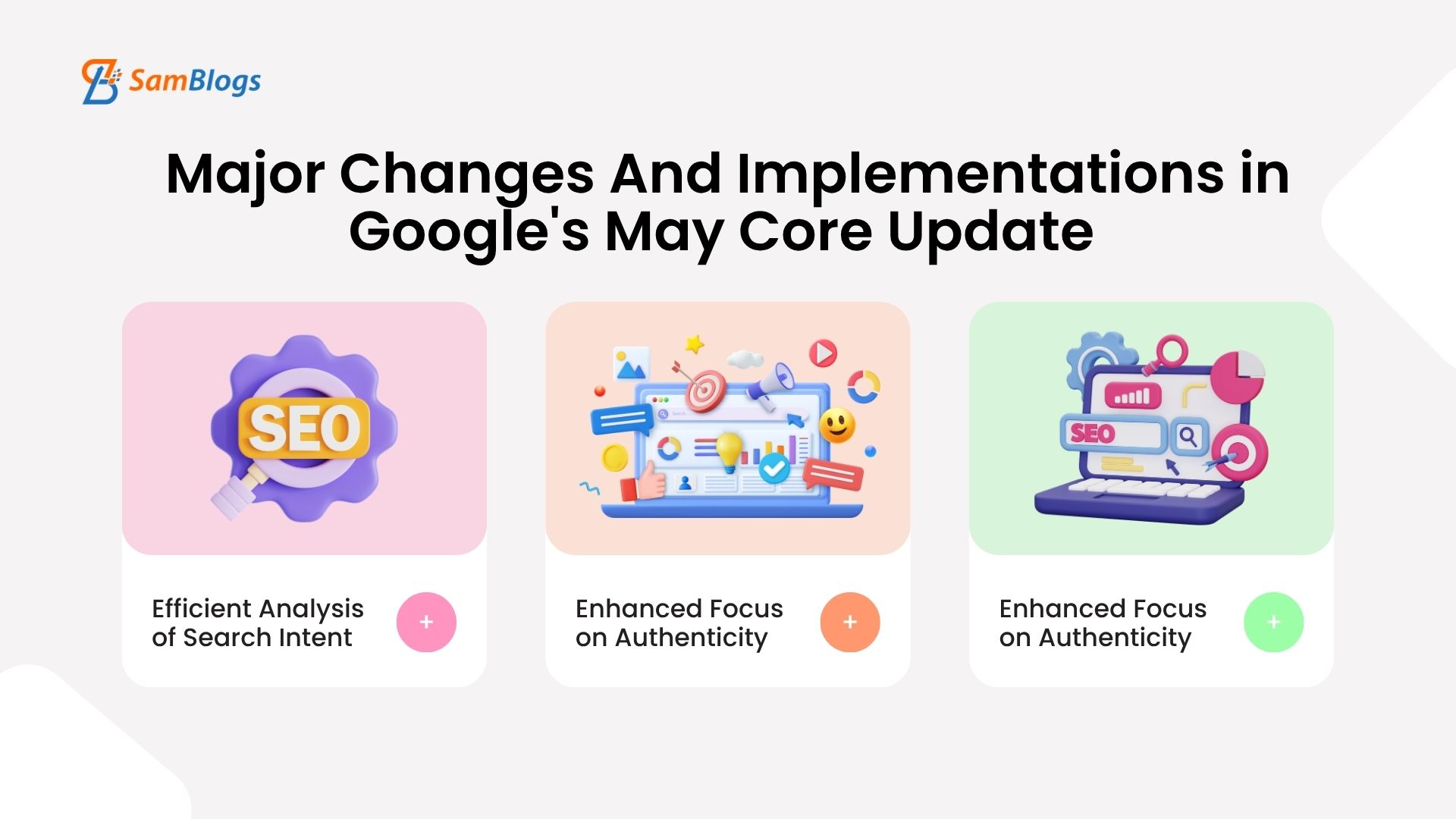
Efficient Analysis of Search Intent
Google’s comprehension of search intent has improved a lot through this update. Previously, the Google ranking system mainly focused on different factors, such as on-page optimizations, similar keyword targeting, and backlinks. However, from the May core update, the content adjustments mainly relied on factors that are:
- User expectations.
- Semantic relevance.
- Contextual significance.
- Conversational questions.
Enhanced Focus on Authenticity
Along with different adjustments that users get from the new core update, Google has also increased its observation of content uniqueness and authenticity.
The internet has become drenched with factors such as templated SEO webpages, rewritten AI content, and duplicated articles. Moreover, Google has currently also become more efficient at detecting factors such as:
- Original perspectives.
- Authentic researches.
- First-hand proficiency.
- Meaningful insights.
Efficient Identification of Low-Value Automation
The Google May core update 2026 has introduced optimized facilities for analyzing AI-driven content quality for both users and industries. More importantly, Google is not actively restricting any AI-originated content itself; instead, the present adjustment mainly operates on identifying various factors like:
- Low-effort automation.
- Superficial data pages.
- Scaled content manufacturing that lacks human oversight.
Efficient Brand Trust Signals
Recently, Google has been putting more importance on factors such as online recognition and website credibility. Also, the Google May core update appears to increase the ranking signals that carry connections towards:
- Transparency.
- Brand Authority.
- Expertise.
- Reliability.
Nonetheless, the brand signals are mainly important because the low-trust and anonymous sites often face hardships in competing against the recognized professionals and established brands.
Different Impacts of Google May Core Update 2026 (Industry-wise)
Google’s May 2026 core update has become a crucial factor for sectors such as health, legal, and finance. Although the update does not target any specific website or content, it generally adjusts the ranking signals among the entire search facility, which shows a significant visibility change in different industries, such as:
Effects on YMYL Sites (Finance, Health, and Legal)
Websites that fall into the category of ‘Your Money Your Life’ (YMYL) have faced significant changes because of the May core update, as they require higher maintenance. For example, some noticeable changes are:
- Efficient visibility for administrative institutions.
- Inclination for professionally reviewed web material.
- Decreased rankings for opinion-driven or unsupported content.
Moreover, medical sites with verified authors and owners can gain significant website traffic from this update. Alongside, the financial or commercial blogs without any proper credentials might notice a decrease in their rankings.
Changes in E-commerce Rankings
E-commerce sites sometimes experience ranking reallocations based on user experience and product webpage quality. Moreover, some of the crucial impacts mainly consist of:
- Optimized rankings for brands with efficient recognition.
- Degradation of the manufacturer’s copy or duplicate product highlights.
- Enhanced value is placed on distinctive product content and user reviews.
Furthermore, websites that offer finer product experiences, such as comparisons, authentic reviews, and images, mainly gain various benefits from the update.
Alterations in Publishing And News Visibility
Alongside YMYL websites and E-commerce pages, content and news publishers sometimes notice major changes in search engine visibility and rankings. Moreover, after the May core update, there are several noticeable changes in this sector, such as:
- Credible and authentic publishers gain visibility through this update.
- Low-authentic or aggregated news content might have low rankings.
- Authenticity and freshness become more significant for ranking stability.
Education, Travel, And Data-oriented Content
Just like many sectors, the data-oriented sectors have also observed a significant shift in their website traffic and ranking, for example:
- Reliable travel sites and official sources have benefited from improved rankings, while generic travel blogs have also lost rankings.
- Google has prominently rewarded expert-driven, structured content, and low-quality tutorial organizations sometimes see their visibility and traffic decline.
Inclusive Ranking Volatility
One of the most immediate effects of the May core update is search ranking changes across all sectors and industries, both small and large. For instance, you can mainly refer to:
- Websites might showcase unexpected traffic drops or increases.
- Webpages that were previously stable for a long time might indicate severe fluctuations.
- Search Engine Result Pages (SERPs) placements sometimes re-evaluate for competitive questions.
The following volatility generally becomes stable within a month or after a few weeks, as the system normally concludes its reassessment.
How to Optimize Your Website for Google May Core Update?
The main purpose of Google’s May core update is to improve search quality by rewarding useful, reliable, and well-structured content.

Moreover, there are many procedures that you can implement to optimise your site for the new update, such as:
Focusing on Authentic Content Value, Not Just SEO Formatting
The most crucial change in recent core updates is to relocate from the content that primarily functions for the search engines. Moreover, for efficiently optimizing your content, here are a few adjustments you can make:
- Writing content that completely answers the user intent, not just keywords.
- Neglecting filler sections that do not include any meaningful data.
- Covering topics deeply enough that website visitors would not need to visit another source.
Strengthening E-E-A-T Signals (Experience, Expertise, Authority, and Trust)
Google actively assesses whether your content is credible and sufficiently authoritative to be cited in AI answers. Generally, you can optimize the E-E-A-T signals (Experience, Expertise, Authority, and Trust) by following several steps, such as:
- Including author names with authentic credentials.
- Highlighting different first-hand experiences, such as authentic examples, case studies, and testing.
- Adding reliable sources in appropriate places.
- Managing an ‘Editorial Policy’ and ‘About’ page.
Improving Content Formation And Depth
Following our previous mentions, Google is not directly targeting any specific sites for a penalty. For instance, it mainly targets webpages and sites that have no authenticity, reliability, or usefulness, and shallow content is one of those negative factors.
Moreover, for improving the following scenario, there are several steps that you can undertake, such as:
- Explaining thin articles into detailed guides.
- Implementing headings such as H1 and H2 for better readability.
- Including different factors like examples, comparisons, and FAQs.
- Neglecting the repetition of the same concept or ideal in cross-sections.
Reducing Duplicate or Low-value Pages
The core updates from Google sometimes devalue or degrade a massive amount of low-quality content. However, to avoid such cases, you can implement several procedures to ensure your ranking, such as:
- Merging or removing similar or duplicate webpages.
- Updates expired or outdated articles instead of making unnecessary new versions.
- Including Noindex webpages that offer little SEO value, such as thin archives and tag pages.
- Consolidation of overlapping topics into administrative webpages.
Improve for Search Intent, Not Just Keywords
The current updates from Google generally rely on intent similarity. Moreover, every webpage should properly satisfy a single intent, while integrating multiple intents mainly reduces relevance. Nonetheless, you can mainly refer to four kinds of search intents, such as:
- Navigational (searching for a brand or webpage).
- Informational (learning something).
- Transactional (purchasing something).
- Financial investigation (comparison options.
Enhancing Internal Linking Tactic
Internal links mainly assist Google in comprehending your website formation alongside your authority flow. For example, some of the best practices include:
- Linking relevant articles contextually.
- Implement the descriptive anchor text.
- Creating topic clusters.
- Making sure crucial webpages receive efficient internal link assistance.
Nonetheless, the entire process generally helps the search engines with improved topical authority and crawlability.
Improving Core Web Vitals And Page Experience
Although content quality is a dominant factor, technical performance still carries a lot of prominence. Moreover, you mainly have to focus on several factors, such as:
- Balanced layout for avoiding content changes.
- Quick loading speed, especially for smartphones.
- Clear user interface with minimal advertisements.
- Mobile-friendly designs.
Negative Impacts of Google May Core Update
Although the Google May core update 2026 has promised better stability, user experience, and high-quality content across the web, a lot of industries, including various SEO experts and web developers, have faced multiple problems, such as:
Unexpected Organic Traffic Decreases
A lot of complaints that have arisen since the release of the May core update mainly revolve around the significant decrease in organic search traffic.
Moreover, sites that used to rank higher on the first page in the past abruptly disappeared from higher positions. Nonetheless, some of the general symptoms consist of:
- Nearly 30 to 80 percent traffic decrease for some websites.
- Dropping of feature snippets.
- Decreased impressions in Google Search Console.
- Keyword rankings falling overnight.
For businesses and organisations that heavily rely on Google traffic, the unexpected traffic reduction can directly influence their leads, sales, and advertisement revenue.
Difficulty for Small Publishers
A lot of category website owners and independent bloggers have complained about significant ranking losses. Moreover, a lot of them generally claim that the higher authority domains are governing the search results, even when smaller sites offer more authentic or data-oriented content. Also, the negative impacts on small publishers mainly include:
- Decreased visibility despite high-quality articles.
- Decreased advertisement revenues.
- Reduction in affiliate commissions.
- Struggling to compete against higher brands.
Technical SEO Problems Becoming More Crucial
The Google May core update mainly aims to benefit the sites that have efficient technical performance. Conversely, it is also devaluing the sites that have:
- Inefficient mobile usability.
- Excessive advertisements.
- Broken webpages.
- Weak content formation.
- Slow loading speed.
Furthermore, the following issues mainly put pressure on organizations and businesses to invest in technical SEO optimizations.
In Conclusion
The Google May core update has significantly reshaped the SEO landscape, creating both challenges and opportunities for SEO experts and website owners. Nonetheless, as Google seeks to optimize search quality and focuses on user-focused, helpful content, many websites have also experienced significant traffic drops, revenue losses, and declines in ranking stability, which has impacted their overall market performance.
FAQs
How long will it normally take for the Google May core update to fully roll out on most devices?
– The Google May core update will generally take about one to three weeks before it is available on most devices.
Why did a lot of website owners face sudden ranking drops after the current May core update from Google?
– A lot of websites have mainly faced ranking drops after the current May core update from Google because of reasons such as content quality, expertise, trust, and user satisfaction.
What kind of sites faced the most negative impact from the new Google core update?
– The sites that are mainly niche websites and the sites that generally contain repetitive or thin content have faced the most negative impact from the recent Google core update.